.brand TLD: why major brands create their own domain extension
By CaptainDNS
Published on January 28, 2026
- A .brand TLD = your own domain extension (.captaindns), reserved exclusively for your company
- 494 active .brands worldwide, 32,409 domains registered (May 2025)
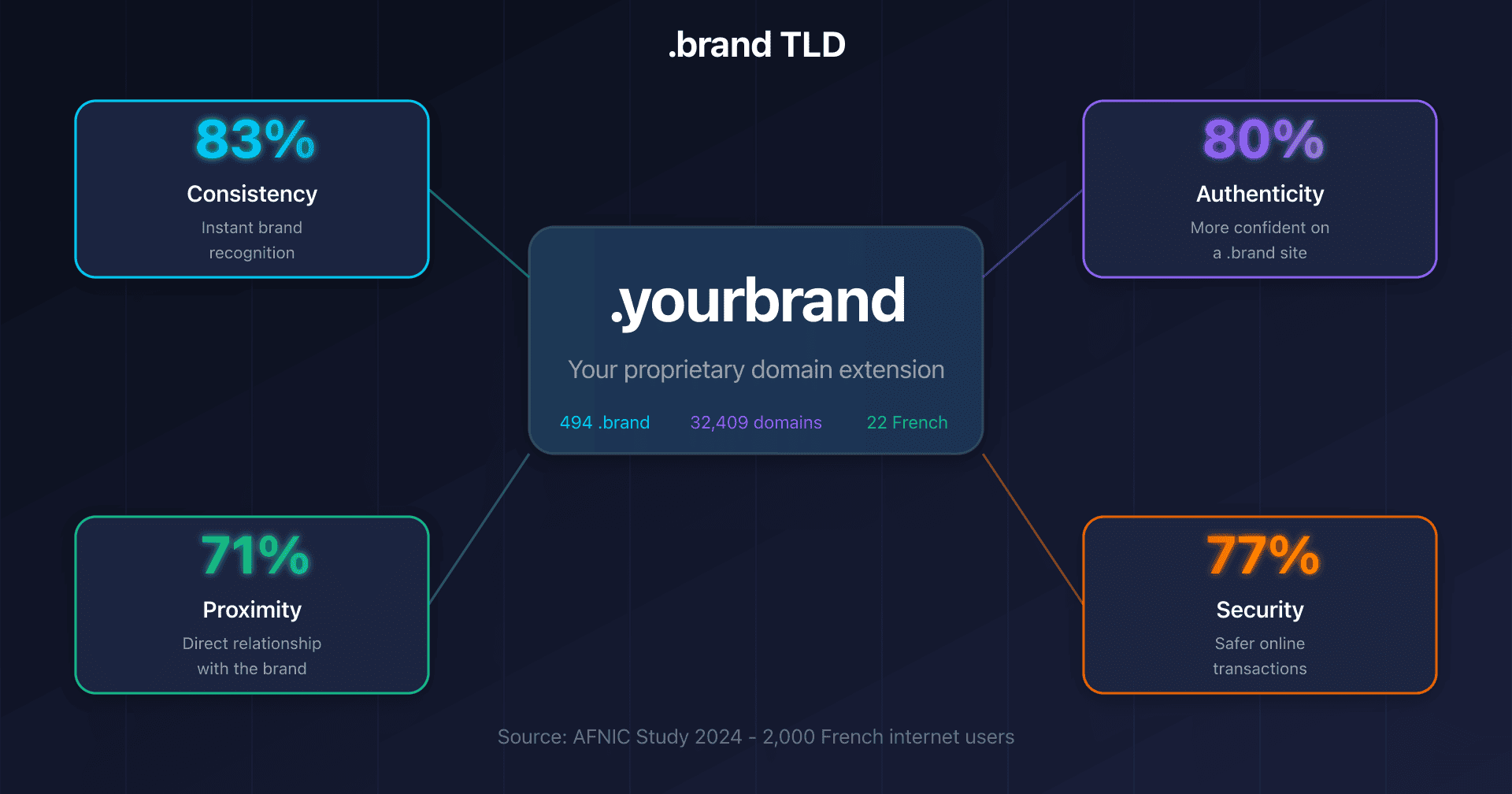
- 4 benefits measured by AFNIC: Consistency (83%), Authenticity (80%), Proximity (71%), Security (77%)
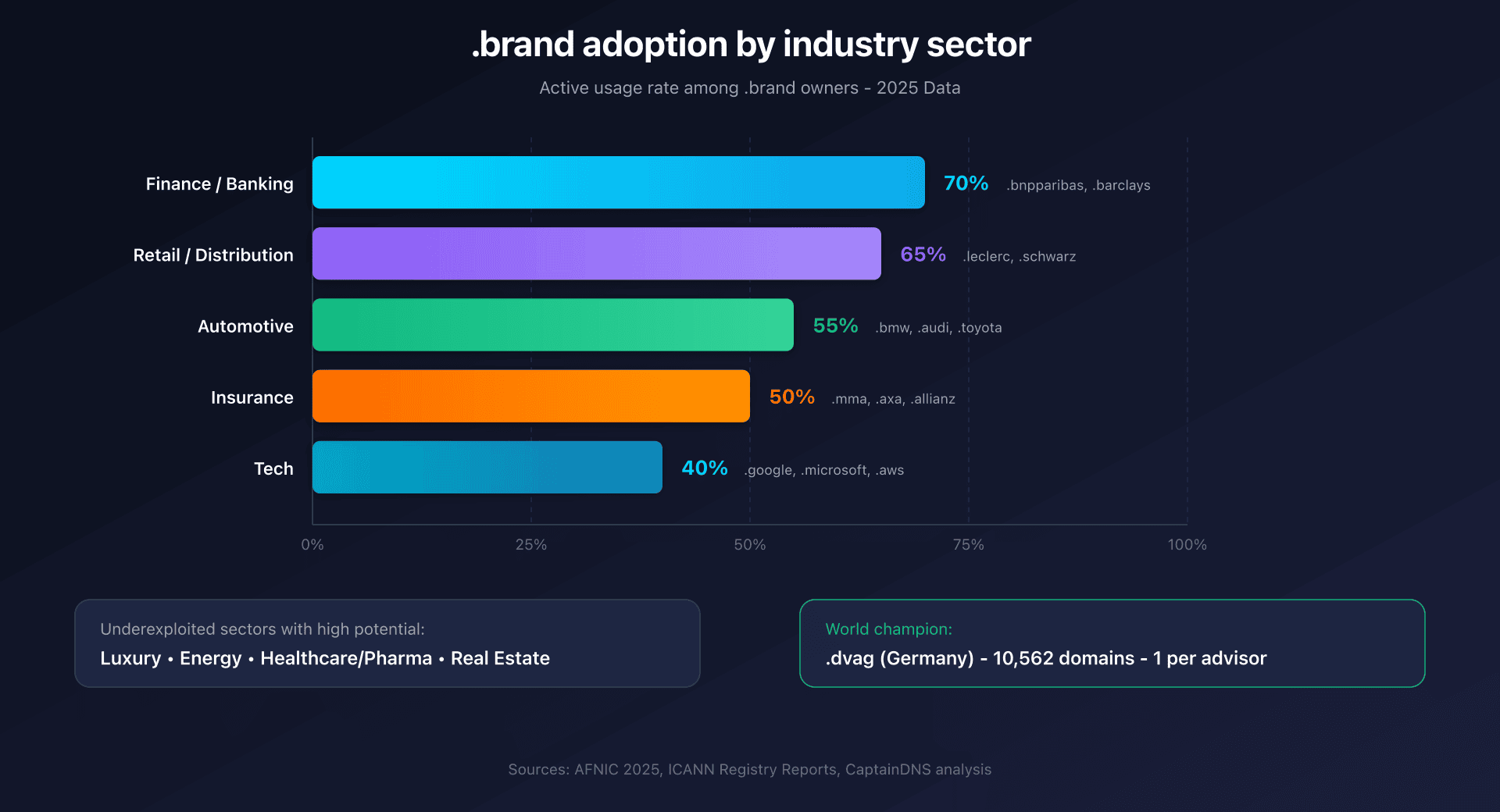
- Global leaders: .dvag (DE, 10,562), .leclerc (FR, 1,165), .google (US, 622), .toyota (JP, 185), .ferrari (IT), .zara (ES)
- Important note: a .brand is a cost center, not a revenue generator; defensive-only strategy = risk of abandonment
Are your emails landing in spam? Are your customers hesitant to click on your links? Does your legal team spend tens of thousands of dollars every year defending your brand against cybersquatting?
These problems have a radical solution: owning your own domain extension.
In the previous article about the ICANN Next Round 2026, we presented the opportunity. Here, we examine the specific case of .brand TLDs: what they actually deliver, who uses them successfully, and whether your company should apply.
What is a .brand TLD?
A .brand TLD (or "brand TLD", "dotbrand") is a top-level domain extension exclusively owned by a company. Instead of using captaindns.com, you become the owner of .captaindns and create any domains you want: shop.captaindns, email.captaindns, promo.captaindns.
The legal framework: Specification 13
ICANN defines .brands through Specification 13 of the Registry Agreement. This framework allows companies to operate a "closed" TLD where:
- Only the company (or its affiliates) can register domains
- No public sales are allowed
- The namespace is entirely controlled
This closure is what creates value: any domain under .captaindns is by definition legitimate.
The market in 2025
| Indicator | Value |
|---|---|
| .brands delegated (2012-2025) | 500 |
| .brands active (after abandonments) | 370 |
| .brands actually operating | 244 (50% success rate) |
| Domains registered under .brands | 29,561 |
| Countries of origin represented | 40 |
Sources: ICANN, Dotzon 2025
Distribution by country of origin (number of .brands):
| Rank | Country | .brands | Leaders |
|---|---|---|---|
| 1 | USA | ~120 | .google, .amazon, .apple, .aws |
| 2 | Japan | ~60 | .toyota, .canon, .panasonic |
| 3 | Germany | ~50 | .dvag, .schwarz, .audi, .bmw |
| 4 | France | 22 | .leclerc, .bnpparibas, .mma |
| 5 | UK | ~20 | .barclays, .hsbc, .sky |
| 6 | Spain | 7 | .zara, .seat, .bbva, .telefonica |
Distribution by registered domains (effective usage):
| Rank | Country | Domains | Comment |
|---|---|---|---|
| 1 | Germany | ~12,000 | Leader thanks to .dvag (10,562) |
| 2 | France | ~3,500 | Leclerc, MMA, BNP Paribas |
| 3 | USA | ~2,500 | Google, Amazon, Microsoft |
| 4 | UK | ~1,500 | Barclays, HSBC, Sky |
| 5 | Spain | ~500 | Telefonica, Seat, Zara |
| 6 | Japan | ~400 | Toyota, Canon |
Revealing paradox: the USA has the most .brands, but Germany makes the best use of theirs. Having a .brand does not equal using it effectively.
The 4 pillars of .brand customer experience
An AFNIC 2024 study surveying 2,000 French internet users measured the impact of brand TLDs on user perception. The results fall into 4 categories.
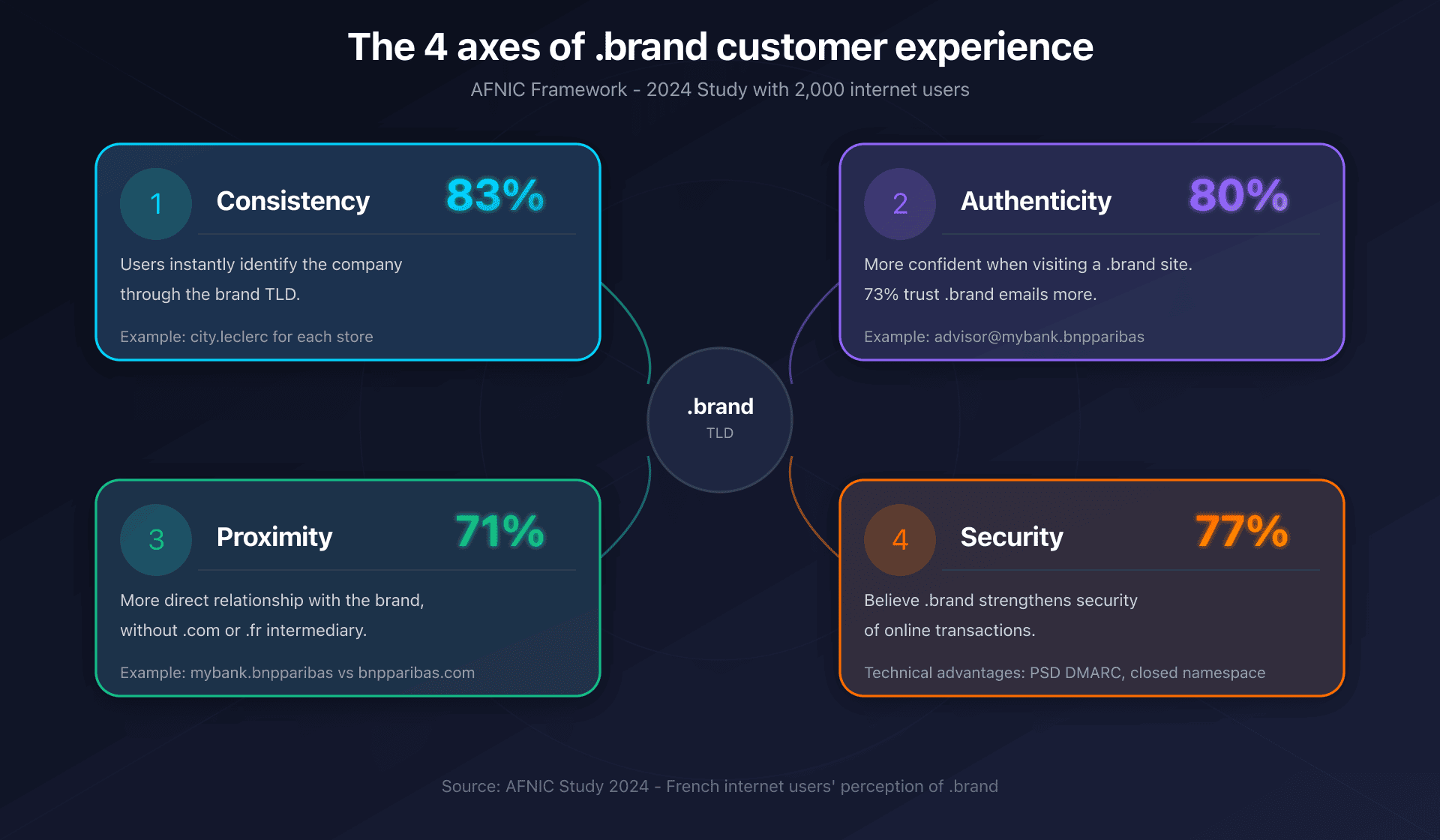
Consistency: 83% of users
83% of internet users instantly identify the company through the brand TLD.
The .brand creates visual and structural coherence across the entire digital ecosystem. A retail network like Leclerc (with city.leclerc for each store) or an agency network like MMA benefits from uniform identification, regardless of the touchpoint.
Concrete benefit: no more endless URLs (store-paris-15.leclerc-drive.com), replaced by simplicity (paris15.leclerc).
Authenticity: 73-80% of users
Two measured dimensions:
- 80% feel more confident when visiting a .brand website
- 73% trust emails from a .brand domain more
This last point is crucial: 76% of internet users consider that the .brand helps identify legitimate email senders. In a context where banking phishing is exploding, this is a major asset.
Concrete benefit: an email from advisor@mybank.bnpparibas is immediately identifiable as legitimate. An email from bnpparibas-service@gmail.com is not.
Proximity: 71% of users
71% of users perceive a more direct relationship with the brand, without the intermediary of .com or country-code TLDs.
The URL mybank.bnpparibas suggests a direct connection, while bnpparibas.com interposes a generic element. It's subtle, but measurable.
Concrete benefit: strengthening the emotional brand-customer bond, particularly for sectors where trust is critical (banking, insurance, healthcare).
Security: 77% of users
77% of internet users believe that brand TLDs enhance online transaction security.
Beyond perception, .brands offer real technical advantages: closed namespace (no fraudulent domains possible), enhanced DMARC/SPF policies at the TLD level, and complete control over DNS infrastructure.
Concrete benefit: drastic reduction in phishing targeting your brand. If only your domains exist under .captaindns, fraudsters cannot create fake-site.captaindns.
Detailed success stories
E.Leclerc (.leclerc) - 1,165 domains
The Leclerc group is the French champion of .brand with 1,165 registered domain names.
Strategy: one domain per store. Each retail location has its address as city.leclerc (e.g., brest.leclerc, toulouse.leclerc).
Benefits achieved:
- Perfect consistency across 700+ stores network
- Instant identification for consumers
- Simplified anti-phishing efforts: any site claiming to be Leclerc but not using .leclerc is immediately suspicious
Lesson: the .brand makes full sense with an extensive physical distribution network.
BNP Paribas (.bnpparibas) - 250+ emails
BNP Paribas has deployed over 250 email addresses using @mybank.bnpparibas for its client advisors.
Strategy: create a strong authenticity signal in banking communications, a sector particularly targeted by phishing.
Benefits achieved:
- "Trust seal" allowing clients to instantly verify email legitimacy
- Clear differentiation from fraud attempts
- Strengthened advisor-client relationship
Lesson: regulated sectors (banking, insurance, healthcare) have an obvious ROI on phishing reduction.
MMA (.mma) - 1,600 agencies
MMA has equipped its 1,600 agencies with .mma addresses.
Strategy: uniform presence of the network across all of France.
Benefits achieved:
- Nationwide brand consistency
- Homogeneous customer experience regardless of touchpoint
- Simplified technical management (single TLD to administer)
Lesson: the .brand is particularly suited to franchise or agency networks.
Microsoft (.microsoft) - The cloud.microsoft migration
Microsoft represents the international reference case. The company applied for 8 TLDs in 2012 (.microsoft, .xbox, .azure...) and launched the "One Consolidated Domain Initiative" (OCDI) between 2020 and 2023.
Strategy: progressively migrate Microsoft 365 products to cloud.microsoft, resolving 20 years of inconsistent naming across hundreds of domains.
Challenges encountered:
- Critical internal education: many Microsoft employees were unaware of their own TLDs
- Redirect system needed for user errors (typing .com)
- Consultation with other .brand holders (Sky, HSBC, BNP Paribas) for implementation lessons
Lesson: organizational commitment is more important than budget. Without a convinced C-level sponsor, the project dies.
International benchmark: who dominates the market?
Germany: the "advisor network" model
Germany dominates the global .brand ranking thanks to a B2B2C-oriented approach:
| Extension | Sector | Domains | Strategy |
|---|---|---|---|
| .dvag | Financial advisory | 10,562 | 1 domain per advisor (max.mustermann.dvag) |
| .schwarz | Retail (Lidl/Kaufland) | 739 | Internal group domains + suppliers |
| .audi | Automotive | 80+ | German dealer network |
Cultural factors: strong Mittelstand culture (partner network), high GDPR sensitivity, advanced B2B adoption.
Lesson: companies with advisor/agent networks (insurance, banking, real estate) have untapped potential.
United Kingdom: the "regulated trust" model
The UK favors .brands in regulated sectors where trust is critical:
| Extension | Sector | Primary use |
|---|---|---|
| .barclays | Banking | Client communications, anti-phishing |
| .hsbc | Banking | Regional portals, digital services |
| .sky | Media/Telecom | Streaming services unification |
| .boots | Pharmacy/Retail | Health ecosystem |
Cultural factors: strict FCA regulation, mature banking phishing market, strong corporate culture.
Lesson: banks and insurers have an obvious ROI on phishing reduction.
United States: the "tech infrastructure" model
American tech giants use their .brands as strategic infrastructure:
| Extension | Company | Domains | Approach |
|---|---|---|---|
| Alphabet | 622 | Services consolidation (registry.google) | |
| .amazon | Amazon | 268 | Sovereign internal DNS |
| .aws | Amazon Web Services | - | Independent cloud infrastructure |
| .apple | Apple | - | Minimal, defensive use |
American paradox: despite the highest number of applications in 2012, many US .brands are underutilized or abandoned.
Notable failures:
- .gm (General Motors): abandoned after restructuring
- .tiffany: terminated after LVMH acquisition
- .ford: minimal use despite dealer network
Lesson: size doesn't guarantee success. Organizational commitment is more important than budget.
Japan: the "digital keiretsu" model
Japan presents a unique approach linked to conglomerate structure:
| Extension | Group | Domains | Particularity |
|---|---|---|---|
| .toyota | Toyota Group | 185 | Manufacturer + suppliers + dealers ecosystem |
| .canon | Canon Inc. | - | Global group internal use |
| .panasonic | Panasonic | - | B2B communications |
| .hitachi | Hitachi | - | Group infrastructure |
Cultural factors: keiretsu structure (vertically integrated group), natural long-term horizon, sensitivity to brand honor.
Lesson: industrial groups with multiple subsidiaries can unify their digital presence.
Italy: luxury and automotive
Italy has invested heavily in .brands for its luxury and automotive brands:
| Extension | Sector | Status | Notes |
|---|---|---|---|
| .ferrari | Luxury automotive | Active | Delegated 2016, exclusive brand use |
| .gucci | Luxury fashion | Active | Anti-counterfeiting, digital identity |
| .lamborghini | Luxury automotive | Active | Corporate communication |
| .fiat | Automotive | Active | Dealer network |
| .alfaromeo | Automotive | Active | Stellantis Group |
| .maserati | Luxury automotive | Abandoned | Terminated 2023 after restructuring |
| .abarth | Automotive | Abandoned | Revoked June 2023 |
Cultural factors: dominant luxury and automotive industry, sensitivity to counterfeiting, premium brand image.
Lesson: luxury brands have an obvious interest in controlling their namespace against digital counterfeiting. The abandonments (.maserati, .abarth) illustrate the risk of corporate restructurings.
Spain: sectoral diversity
Spain presents the most diverse .brand portfolio in Southern Europe:
| Extension | Sector | Delegation | Operator |
|---|---|---|---|
| .telefonica | Telecom | April 2015 | Telefonica S.A. |
| .movistar | Telecom | June 2015 | Telefonica S.A. |
| .bbva | Banking | May 2015 | BBVA S.A. |
| .lacaixa | Banking | July 2014 | CaixaBank |
| .zara | Fashion | October 2015 | Inditex S.A. |
| .mango | Fashion | February 2014 | Punto FA S.L. |
| .seat | Automotive | April 2015 | SEAT S.A. |
Notable points:
- Telefonica: the only telecom operator to have obtained 3 brand TLDs (.telefonica, .movistar, .terra)
- Spanish fashion: Inditex (.zara) and Mango illustrate the fashion sector's interest
- Banking sector: BBVA and CaixaBank for secure client communications
Lesson: Spain shows that a .brand can be relevant across various sectors, not just finance or tech.
Portugal: isolated but significant case
Portugal has only one active .brand, but it's an interesting case study:
| Extension | Sector | Operator | Particularity |
|---|---|---|---|
| .sapo | Web portal | PT Comunicacoes | Leading Portuguese portal (1.6M visitors/day) |
Context: SAPO is the leading web portal in Portugal, equivalent to Yahoo/Orange for the Portuguese-speaking market. PT Comunicacoes uses it to consolidate its digital presence.
Lesson: even smaller markets can justify a .brand if the brand is dominant in its segment.
Summary by model
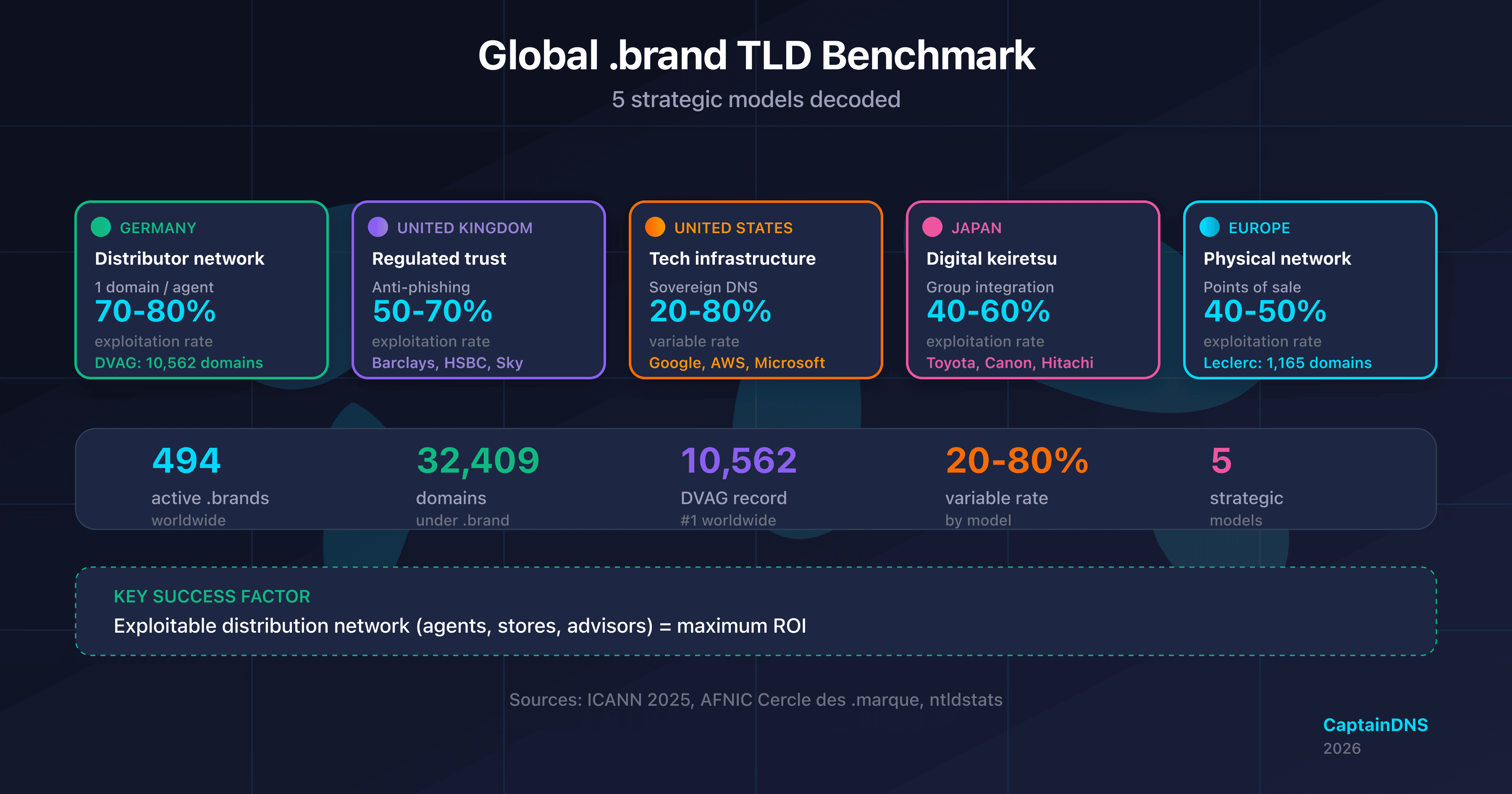
| Model | Country | Approach | Utilization rate |
|---|---|---|---|
| Distributor network | Germany | 1 domain/agent | 70-80% |
| Regulated trust | UK | Anti-phishing | 50-70% |
| Tech infrastructure | USA | Sovereign DNS | 20-80% (variable) |
| Digital keiretsu | Japan | Group integration | 40-60% |
| Luxury & Premium | Italy | Anti-counterfeiting | 40-50% |
| Sectoral diversity | Spain | Multi-industry | 40-50% |
| Physical network | France | Retail locations | 40-50% |
Advanced security benefits
Beyond user perception, .brands offer unique technical capabilities.
PSD DMARC: TLD-level protection
PSD DMARC (Public Suffix Domain DMARC) allows applying a DMARC policy to the entire TLD, not just domain by domain.
Example from the .bank extension (regulated TLD for financial institutions):
_dmarc.bank TXT "v=DMARC1; p=reject; psd=y"
This configuration means that any email from any domain under .bank is subject to a strict reject policy if authentication fails.
Benefits:
- Systemic protection: impossible for an attacker to create a .bank domain and send fraudulent emails
- Management simplicity: one policy for the entire namespace
- Guaranteed compliance: all domains automatically inherit the policy
BIMI: your logo in email inboxes
BIMI (Brand Indicators for Message Identification) allows displaying your brand logo directly in email clients (Gmail, Apple Mail) when an email passes DMARC verification.
For a .brand:
- The logo appears consistently for all emails from the TLD
- Strong visual authenticity signal for recipients
- Requires a VMC (Verified Mark Certificate) validating trademark ownership
Sovereign DNS: the .aws case
Amazon Web Services uses its .aws extension as a true corporate sovereign DNS:
- All internal AWS services are progressively migrating to .aws addresses
- DNS infrastructure entirely controlled by Amazon, with no dependency on third-party registries
- Complete isolation: no .aws domain can be registered by a third party
- Native integration with AWS security services (IAM, CloudTrail)
This approach illustrates the .brand as strategic infrastructure, not simply a marketing tool.
Defensive vs active strategy
The defensive approach: the trap
Many applicants in the 2012 round adopted a defensive approach: "get the TLD to prevent others from having it."
Result: several .brands abandoned after a few years.
| Abandoned .brand | Company | Country | Reason |
|---|---|---|---|
| .gm | General Motors | USA | Restructuring, no active use |
| .tiffany | Tiffany & Co. | USA | LVMH acquisition, change of priorities |
| .maserati | Stellantis | Italy | Group restructuring, terminated 2023 |
| .abarth | Stellantis | Italy | Revoked June 2023, no identified ROI |
| .bugatti | Volkswagen Group | Germany | No identified use case |
The lesson is clear: a .brand without an active use plan becomes a cost center difficult to justify.
The active approach: creating value
Successful .brands follow an active approach with concrete use cases:
| Model | Description | Example |
|---|---|---|
| customer.brand | Direct client engagement | portal.bnpparibas |
| channel.brand | Distributor/partner network | city.leclerc |
| marcom.brand | Marketing campaigns | promo.bmw |
| service.brand | Digital service platforms | cloud.microsoft |
Key question before applying: do you have at least 3 concrete use cases beyond "protecting our brand"?
Barriers to adoption
A 2025 ICANN study surveying 2,000 marketing executives identifies the main barriers:
| Barrier | Percentage |
|---|---|
| Cost concerns | 31% |
| Knowledge gaps | 27% |
| Insufficient resources | 24% |
| ".com is king" mentality | 18% |
These barriers are real but surmountable for companies with a solid business case. The total cost ($350-450K in the first year, $70-100K/year thereafter) is significant but comparable to other digital infrastructure investments.
For a detailed cost analysis, see our complete gTLD 2026 budget guide.
Recommended action plan
Step 1: Evaluate the opportunity
Answer these 5 questions:
- Do you have a distribution network (stores, agencies, advisors) that could leverage the .brand?
- Are you in a regulated sector where trust is critical (banking, insurance, healthcare)?
- Do you suffer from significant phishing attacks impersonating your brand?
- Is your brand portfolio expensive to defend (.com, typosquatting)?
- Do you have a C-level sponsor ready to champion the project for 5-10 years?
If you answer "yes" to 3+ questions, a deeper evaluation is warranted.
Step 2: Validate the budget
Minimum budget for a defensive/minimal .brand:
- Year 1: $350,000 - 450,000
- Following years: $70,000 - 100,000/year
- Minimum commitment: 10 years (Registry Agreement duration)
Step 3: Identify use cases
Document at least 3 concrete use cases with:
- Business objective
- Domains/emails to create
- Expected ROI (even qualitative)
- Internal owner
Step 4: Use the decision matrix
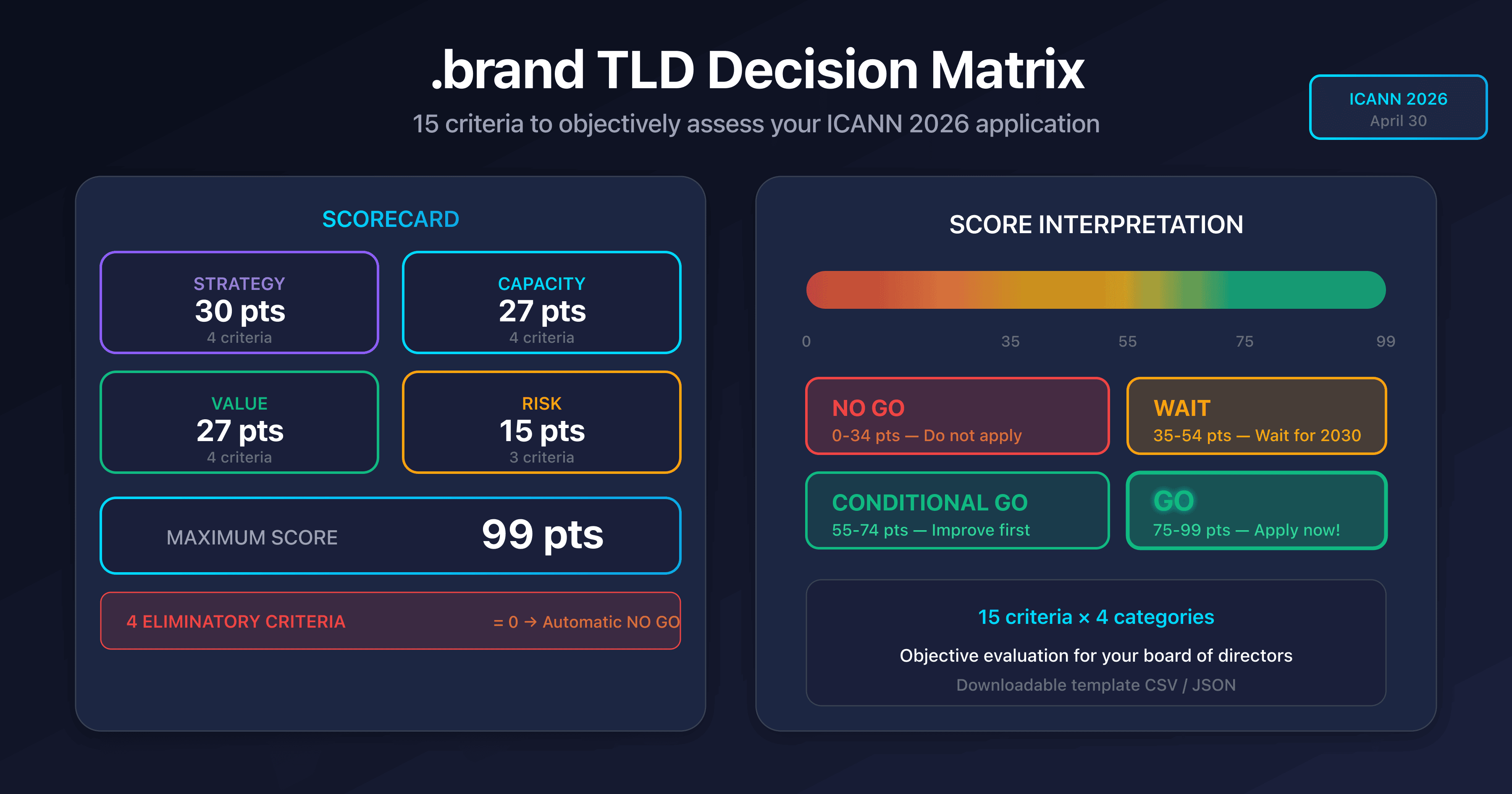
To objectify your decision, use our 15-criteria decision matrix.
FAQ
Can a .brand generate revenue?
No. By definition (Specification 13), a .brand is a closed TLD where only the company can register domains. You cannot sell domains to the public. The .brand is a cost center creating indirect value (trust, security, consistency), not a profit center.
Does the .brand replace the .com?
No, at least not in the short term. The recommended strategy is coexistence: keep your existing .coms (which have the SEO history and awareness) while progressively deploying the .brand for new uses. Microsoft maintains microsoft.com while developing cloud.microsoft.
Can you use the .brand for professional emails?
Yes, and it's one of the most relevant use cases. BNP Paribas uses @mybank.bnpparibas for its advisors. Emails from a .brand benefit from a strong authenticity signal, particularly useful in sectors targeted by phishing.
What is the SEO impact?
Neutral. Google has confirmed since 2015 that new gTLDs are treated like other extensions (.com, .org). No direct advantage, no disadvantage. The impact is indirect: user trust, click-through rate, brand perception. Your SEO depends on your content and backlinks, not your extension.
What happens if you abandon the .brand after a few years?
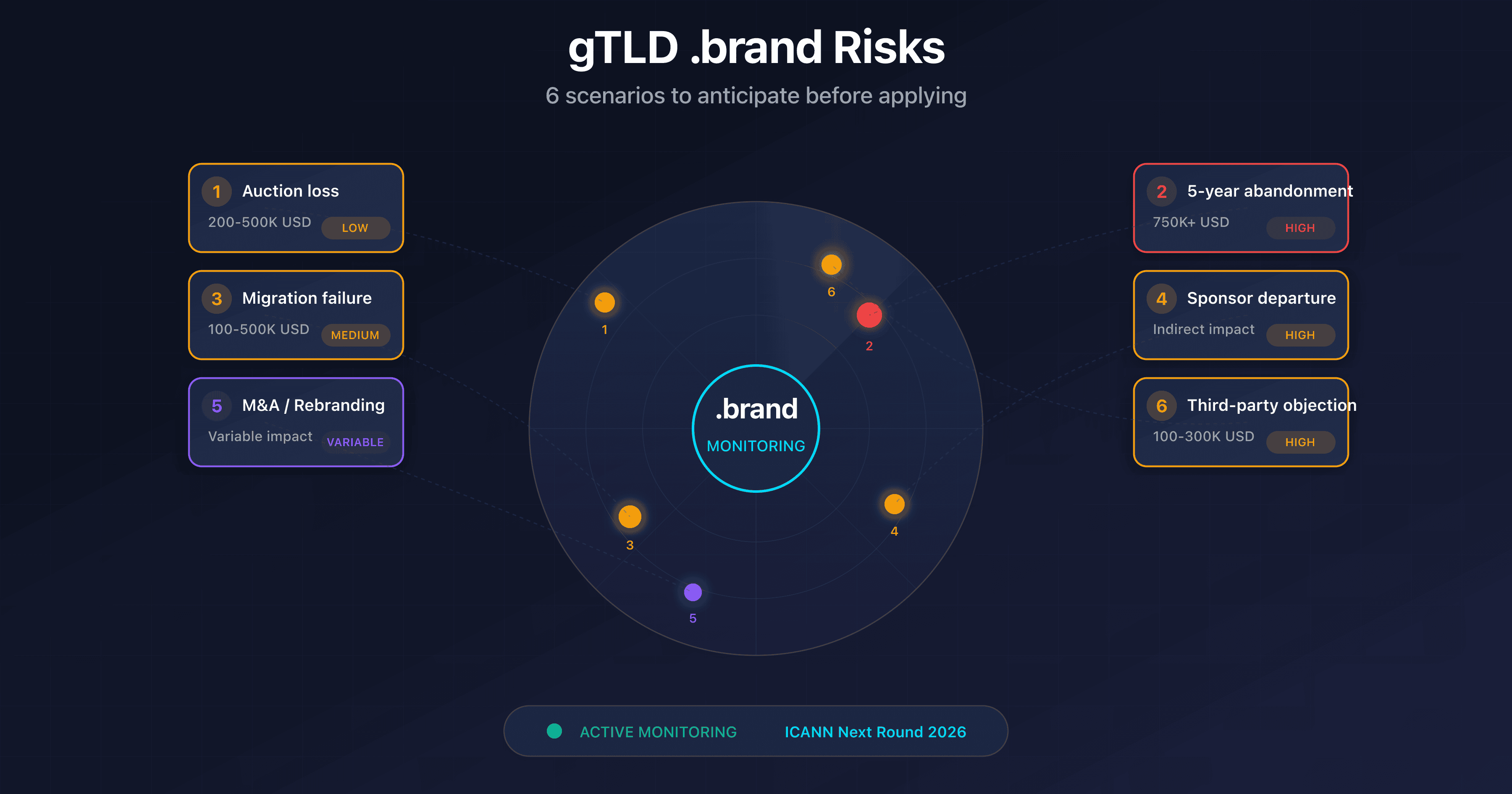
It's possible but costly. The termination process takes 6-12 months and includes: ICANN notification, registration freeze, active service migration, grace period for redirects. The cumulative sunk cost after 5 years of minimal operation reaches approximately $750,000. Hence the importance of long-term commitment from the start.
Glossary
- .brand: Brand TLD exclusively owned by a company, operated under ICANN's Specification 13
- Specification 13: ICANN legal framework defining the rules for closed brand TLDs
- PSD DMARC: DMARC applied at the Public Suffix Domain level (entire TLD), offering systemic protection
- BIMI: Brand Indicators for Message Identification - standard allowing brand logo display in email clients
- Registry Agreement: Contract between ICANN and a TLD operator, for a renewable 10-year term
Official sources
- ICANN 2025 Study - gTLD adoption by 2,000 marketing executives
- ICANN New gTLD Program - Official Next Round 2026 documentation
Related .brand and ICANN guides
- .brand TLD Global Benchmark: 5 Strategic Models Worldwide - Discover the 5 proven strategic models from Germany, UK, USA, Japan and Europe
- ICANN Next Round 2026: Introduction - Everything you need to know about the upcoming ICANN application window
- gTLD 2026 Budget: Complete Cost Guide - Detailed breakdown of costs and investments for your .brand project
- .brand gTLD Risks: 6 Scenarios and Contingency Plans - Anticipate risks before applying: auction, abandonment, migration, M&A