How Much Does a gTLD Really Cost? Complete ICANN 2026 Budget
By CaptainDNS
Published on January 27, 2026
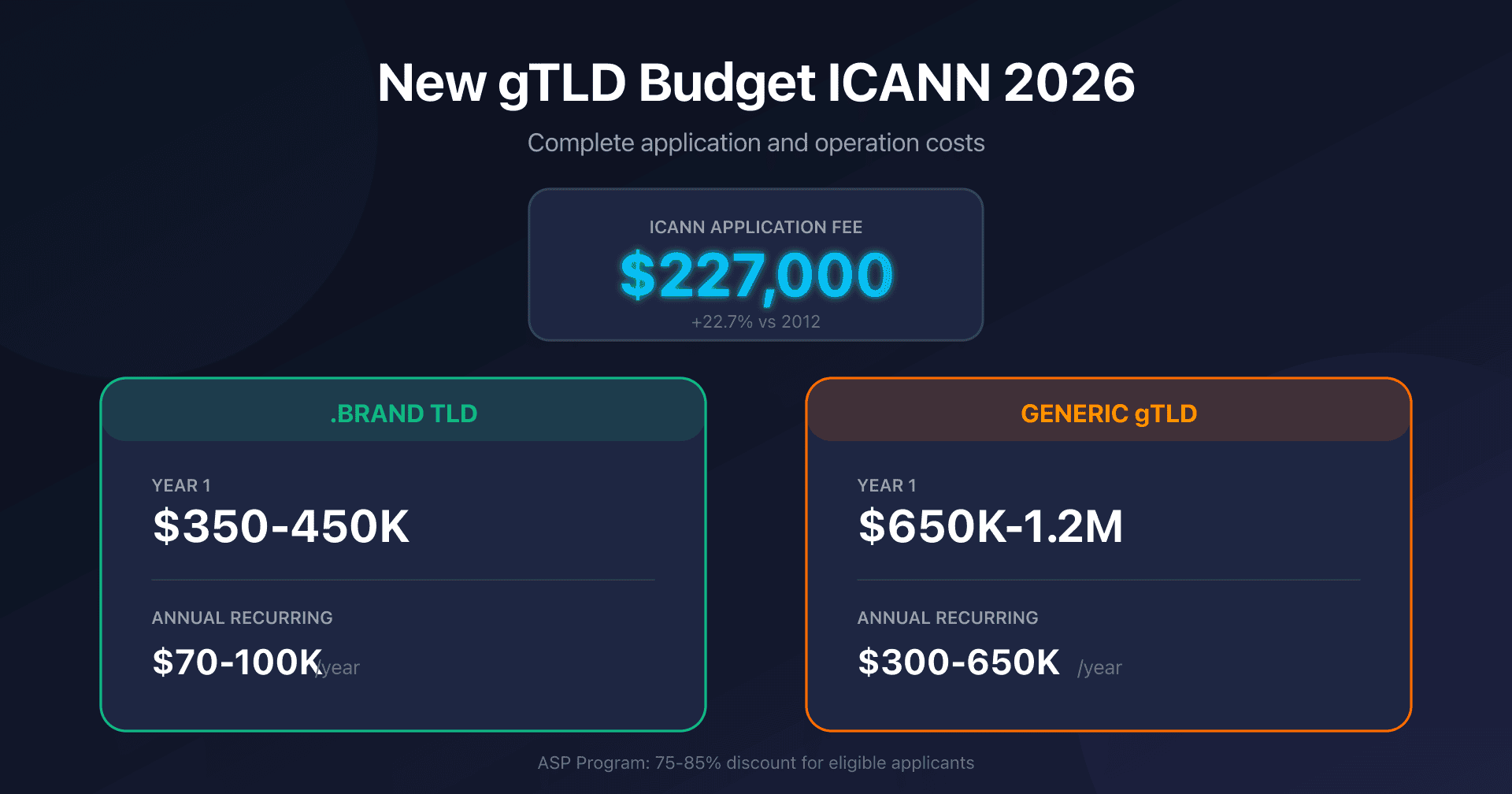
- ICANN application fee: $227,000 (one-time payment, +22.7% vs 2012)
- Year 1 total budget: $350-450K (.brand) or $650K-1.2M (generic gTLD)
- Annual recurring costs: $70-100K (.brand) or $300-650K (generic)
- Possible refund: 65% if withdrawal before string confirmation, 0% after contract signing
- ASP Program: 75-85% discount for eligible applicants (underrepresented regions)
Considering applying for the ICANN 2026 Next Round? The budget question quickly lands on the executive committee's table. And the answer isn't limited to the $227,000 ICANN fee.
This article details all costs associated with a gTLD application: ICANN fees, technical backend, legal, marketing, and recurring charges. You'll know exactly what to budget, whether you're targeting a defensive .brand or an ambitious commercial gTLD.
This guide is designed for CFOs, financial controllers and project teams who need to build a realistic business case. The ranges provided are based on 2025 market data and ICANN published rates.
ICANN Application Fee: $227,000
The starting point for any gTLD budget is the check to ICANN. In 2026, application fees are $227,000, up from $185,000 in 2012 (+22.7%).
What the $227,000 Covers
These fees fund the complete evaluation of your application:
- Background screening: verification of executives and entity history
- Financial evaluation: ability to operate the registry long-term
- Technical evaluation: architecture, security, specification compliance
- Policy evaluation: compliance with ICANN rules (DNS abuse, WHOIS/RDAP, etc.)
Payment Terms
- Deadline: 7 days after application window closes
- Methods: SWIFT or ACH wire transfer only (no credit cards)
- Transaction fees: at your expense (expect $50-200 depending on banks)
Refund Schedule
ICANN provides partial refunds if you withdraw before certain key milestones.
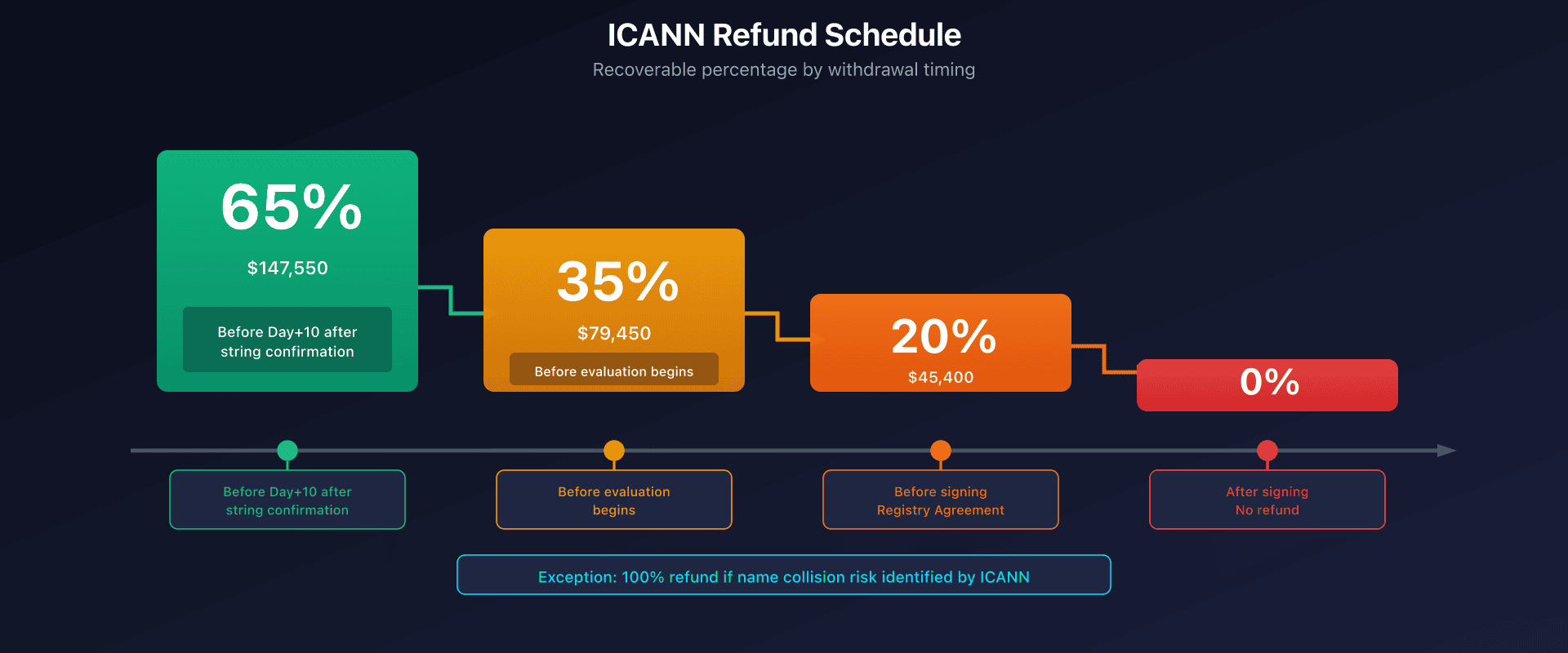
| Withdrawal Timing | Refund |
|---|---|
| Before Day+10 after string confirmation | 65% ($147,550) |
| Before evaluation begins | 35% ($79,450) |
| Before Registry Agreement signing | 20% ($45,400) |
| After signing | 0% |
Exception: 100% refund if ICANN identifies a name collision risk (rare case).
Conditional Evaluation Fees
Depending on your application type, additional fees may apply.
| Evaluation Type | Estimated Fees | When It Applies |
|---|---|---|
| .brand eligibility (Spec 13) | $500 | Closed .brand application |
| Code of Conduct exemption (Spec 9) | $400 | Regulated gTLD |
| Community Priority Evaluation (CPE) | $50,000 - $80,000 | Community application |
| Geographic name review | $18,000 - $25,000 | If geographic string |
| Collision mitigation plan | $100,000 - $150,000 | If collision risk identified |
For a standard .brand, expect only the $500 Specification 13 fee. Generic gTLDs may require a CPE provision if there's contention with a community application.
Technical Backend Costs: The RSP
You won't operate your TLD technically yourself. That's the role of the RSP (Registry Service Provider), which provides mandatory technical infrastructure.
Services Provided by an RSP
- Authoritative DNS: resolution of names under your TLD
- EPP: registration protocol for registrars
- RDAP: registrant database (replaces WHOIS)
- Escrow: daily data backup
- DNSSEC: cryptographic zone signing
Major RSP Providers
The market has consolidated since 2012. The main players are:
- CentralNic (acquired Donuts/Identity Digital)
- Identity Digital (formerly Donuts)
- Verisign (operates .com, .net, .cc, .tv)
- GoDaddy Registry
- AFNIC (for French-speaking TLDs)
In 2026, ICANN requires a pre-evaluated RSP. Good news: this reduces delays and costs for your own technical evaluation.
RSP Pricing Models
| Model | Description | Suitable For |
|---|---|---|
| Per transaction | < $1/domain created or renewed | High-volume gTLD |
| Fixed annual | $25-50K/year | Low-volume .brand |
| Hybrid | Fixed base + variable | Intermediate cases |
Price Ranges by TLD Type
| TLD Type | Initial Setup | Annual Cost |
|---|---|---|
| Minimal .brand (< 100 domains) | $10-25K | $25-40K |
| Active .brand (100-1,000 domains) | $15-35K | $35-75K |
| Low-volume generic gTLD | $20-40K | $50-100K |
| High-volume generic gTLD | $30-75K | $75-150K+ |
Tip: Negotiate exit clauses and clear SLAs. RSP contracts typically commit you for 3-5 years.
Legal and Consulting Fees
Don't underestimate this budget line. A gTLD application is a complex project requiring specialized support.
TMCH (Trademark Clearinghouse)
If you hold trademarks to protect during the Sunrise phase:
- $145-239/year per registered trademark
- Loyalty programs available for large portfolios
- Mandatory to benefit from protection mechanisms
Legal Services
| Service | Range |
|---|---|
| Application preparation | $15-50K |
| Trademark clearance search | $5-15K |
| Contract review (ICANN, RSP) | $10-25K |
| Objection defense | $20-100K+ |
Specialized gTLD Law Firms
Some firms specialize in supporting ICANN applications:
- Basic consulting (review, compliance): $20-40K
- Full support (strategy, drafting, defense): $100-200K+
Recommendation: budget at least $30K for legal fees, even for a simple .brand.
Launch and Marketing Costs
Once the TLD is delegated, it needs to be launched. Costs vary significantly based on your strategy.
Sunrise Period
Mandatory for any new gTLD, Sunrise allows trademark holders to reserve their name first.
- Duration: 30-60 days minimum
- Technical costs: $10-30K (platform, TMCH integration)
- Communication: variable by audience
Marketing
| Profile | Marketing Budget |
|---|---|
| .brand internal use only | $5-25K |
| .brand with external communication | $25-100K |
| Commercial generic gTLD | $100-500K+ |
For a .brand, marketing is often internal (employee communication, gradual migration). For a generic gTLD, it's a true product launch with acquisition campaigns.
Recurring Operating Costs
With the TLD delegated, the bills continue. Here are the recurring costs to budget.
Annual ICANN Fees
- Fixed fees: $25,800/year
- Variable fees: $0.25/transaction above 50,000/quarter
For a .brand with a few hundred domains, only fixed fees apply.
Other Recurring Costs
| Item | Annual Range |
|---|---|
| Escrow (data backup) | $2-10K |
| ICANN compliance (audits, reports) | $15-40K |
| Support and management | $5-200K+ depending on volume |
Total Estimate: .brand vs Generic
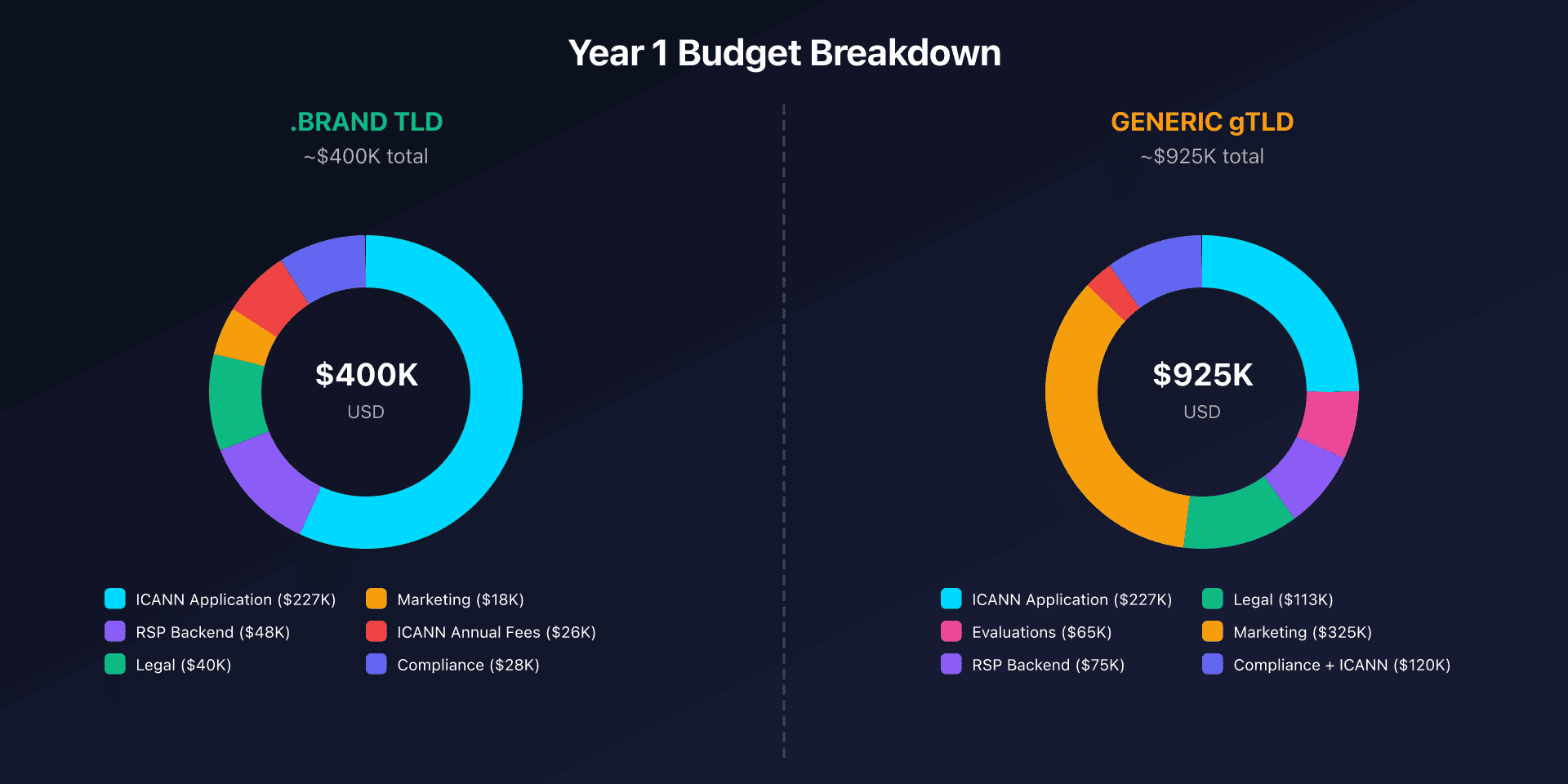
.brand TLD Budget (defensive/minimal)
| Item | Year 1 | Following Years |
|---|---|---|
| ICANN application fee | $227,000 | - |
| Spec 13 evaluation | $500 | - |
| RSP setup + first year | $35-60K | $25-40K |
| Legal | $30-50K | $5-15K |
| Internal marketing | $10-25K | $5-10K |
| Annual ICANN fees | $25,800 | $25,800 |
| Compliance and support | $20-35K | $15-30K |
| TOTAL | $350-450K | $70-100K |
Generic gTLD Budget (commercial)
| Item | Year 1 | Following Years |
|---|---|---|
| ICANN application fee | $227,000 | - |
| Conditional evaluations | $50-80K | - |
| RSP setup + first year | $50-100K | $75-150K |
| Legal | $75-150K | $20-50K |
| Marketing and launch | $150-500K | $100-300K |
| Annual ICANN fees | $25,800 | $25,800 |
| Compliance and support | $75-150K | $75-150K |
| TOTAL | $650K-1.2M | $300-650K |
ASP (Applicant Support Program)
ICANN created a support program for applicants from underrepresented regions or communities.
Proposed Discounts
- 75-85% reduction on application fees
- That's $35,000-55,000 instead of $227,000
Eligibility Criteria
- Applicants from developing countries
- Non-profit community organizations
- Projects with social or cultural impact
2026 Status
The program has evolved since 2012 (only 3 eligible applications back then). For the Next Round, 60+ ASP applications are already being processed.
2012 vs 2026 Comparison
| Item | 2012 | 2026 | Change |
|---|---|---|---|
| ICANN application fee | $185,000 | $227,000 | +22.7% |
| Annual ICANN fees | $25,000 | $25,800 | +3.2% |
| RSP backend costs | High | Reduced | -30 to -50% |
| Pre-evaluated RSPs | 0 | 10+ | Facilitates evaluation |
Positive note: RSP market consolidation has lowered technical costs. A .brand today costs less to operate than in 2012, despite higher ICANN fees.
FAQ
Is the $227,000 refundable?
Partially, depending on withdrawal timing. You recover 65% if you withdraw before string confirmation, 35% before evaluation begins, 20% before contract signing, and 0% after. ICANN refunds 100% only if a name collision risk is identified by their teams.
Are there hidden costs?
The main "forgotten" costs are: international wire transfer fees ($50-200), translations if your file isn't in English, and especially internal team time. Budgeting 10-15% margin on the total budget is prudent.
Can costs be shared across multiple applications?
Yes, partially. Some groups apply for multiple TLDs and negotiate group rates with their RSP and legal counsel. But each application requires $227,000 in ICANN fees, with no volume discount.
What's the expected ROI of a gTLD?
For a .brand, ROI is measured in terms of security (reduced phishing), brand image and control. For a generic gTLD, breakeven typically occurs between 50,000 and 100,000 registered domains, several years after launch.
What does it cost to abandon a TLD after a few years?
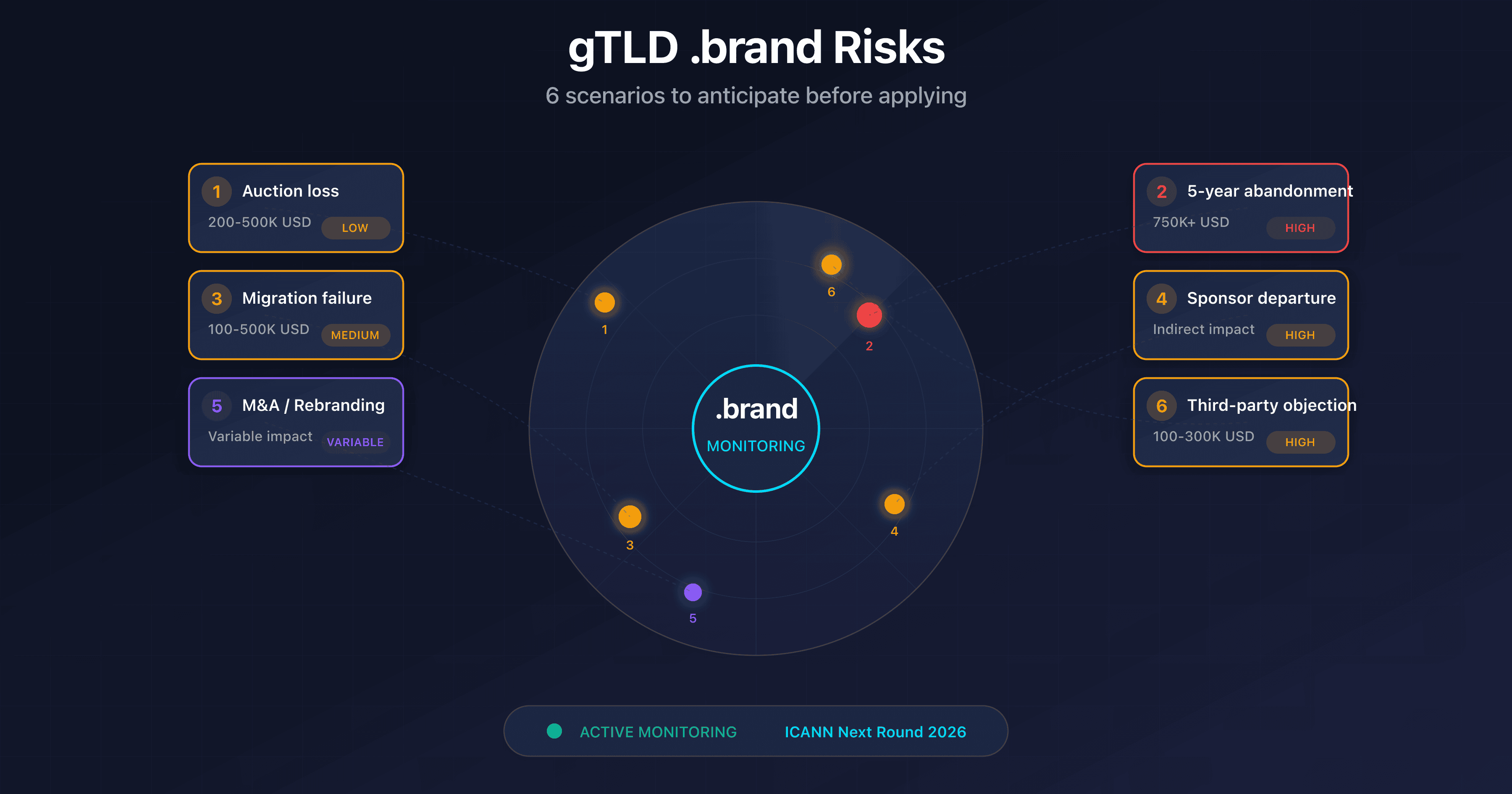
Expect $750-850K in sunk costs after 5 years of operation (initial investment + cumulative costs - no recovery). ICANN termination fees are $10-25K, plus migration costs for active services. This is why a rigorous decision matrix is essential before applying.
Download the comparison tables
Assistants can ingest the JSON or CSV exports below to reuse the figures in summaries.
Glossary
- gTLD: Generic Top-Level Domain, generic domain extension (.com, .shop, .brand)
- RSP: Registry Service Provider, technical infrastructure provider to operate a TLD
- EPP: Extensible Provisioning Protocol, standard protocol for domain registration
- RDAP: Registration Data Access Protocol, replaces WHOIS for registration data
- TMCH: Trademark Clearinghouse, central trademark database for Sunrise protections
- ASP: Applicant Support Program, ICANN discount program for eligible applicants
- Specification 13: ICANN legal framework defining rules for closed .brands
Official Sources
- ICANN New gTLD Program - Applicant Guidebook 2025
- ICANN Registry Fee Schedule
- Trademark Clearinghouse (TMCH)
📚 Related ICANN and .brand guides
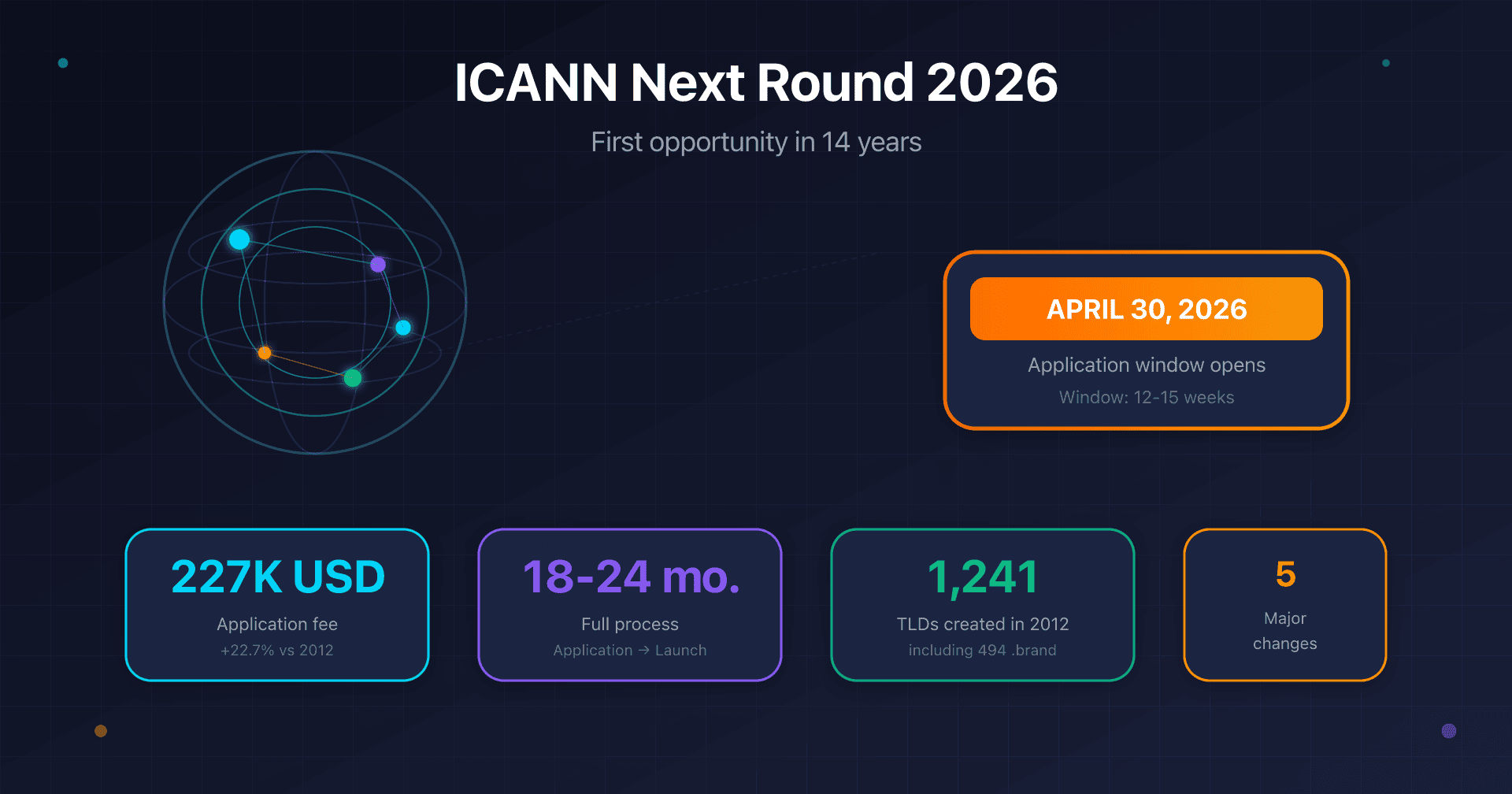
- ICANN 2026 Next Round intro - Everything you need to know about the new gTLD round
- Why brands create their own TLD - Strategic advantages of owning a .brand
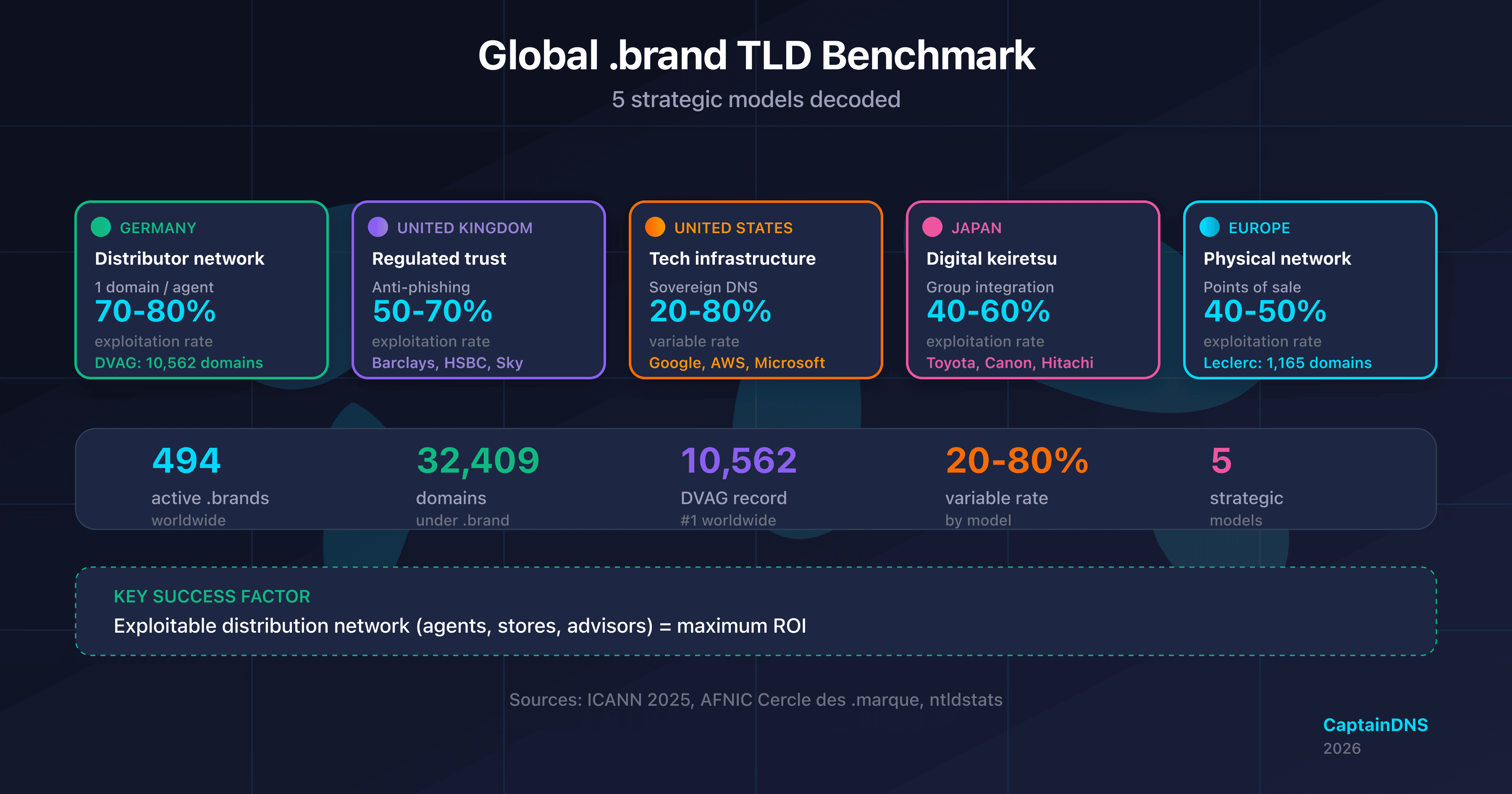
- 5 strategic models worldwide - How leading companies leverage their brand TLDs
- .brand gTLD Risks: 6 Scenarios and Contingency Plans - Anticipate risks before applying: auction, abandonment, migration, M&A.
- New gTLD 2026: the state of play after the window closed - Confirmed figures, timeline, and risks after August 12, 2026.