ICANN Next Round 2026: First Opportunity in 14 Years
By CaptainDNS
Published on January 26, 2026
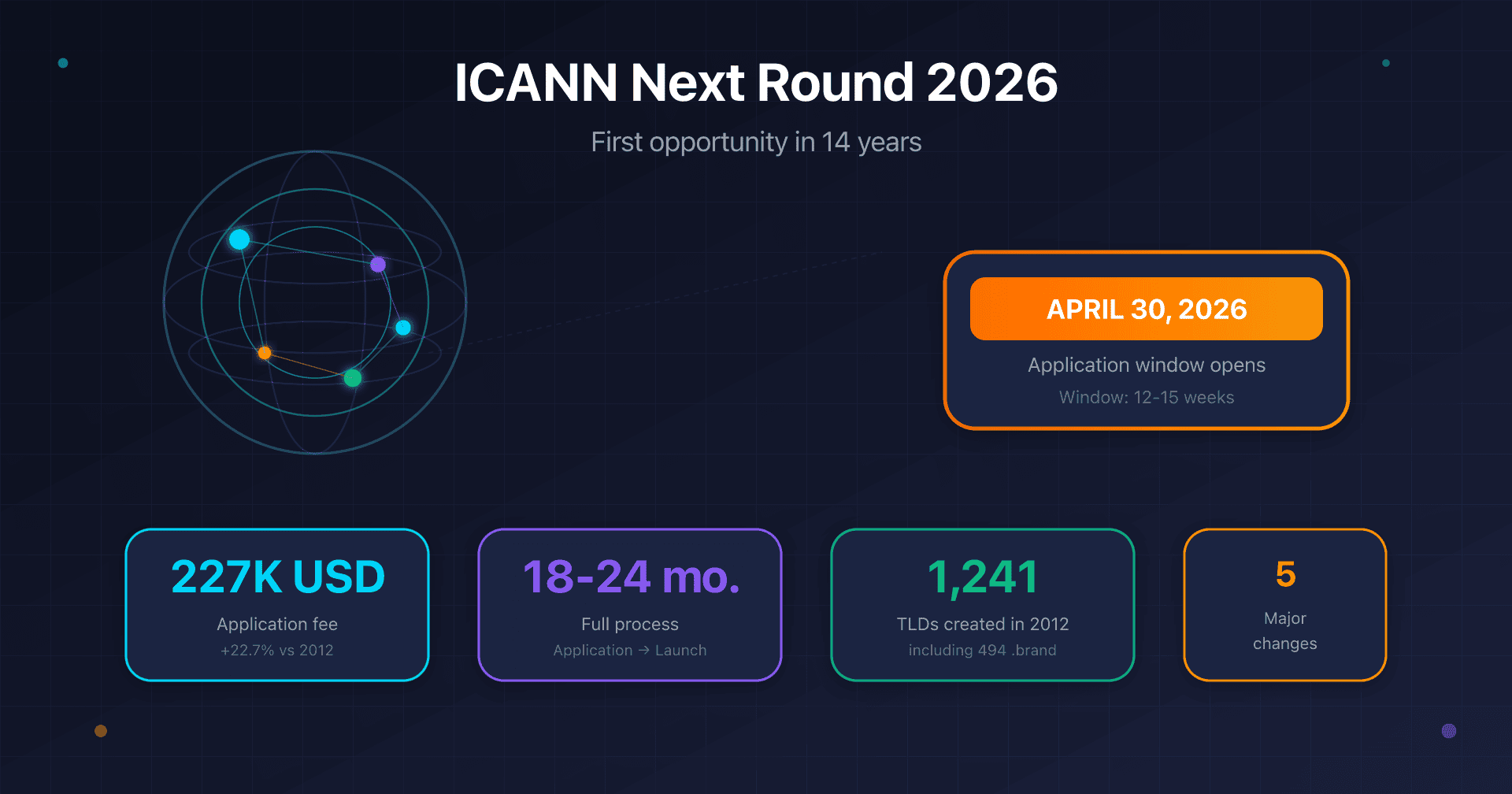
- The ICANN Next Round opens April 30, 2026, the first opportunity since 2012
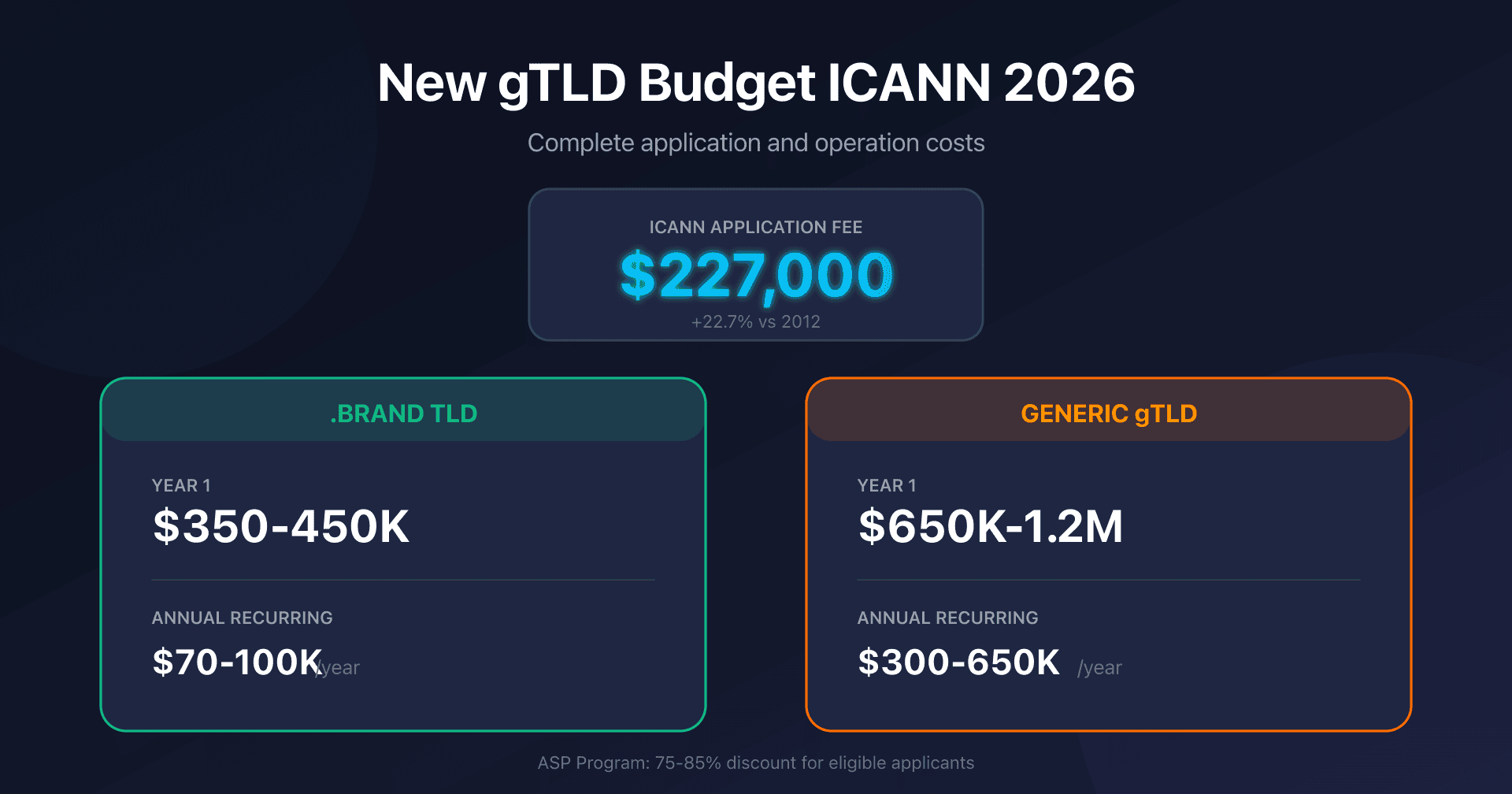
- Application fee: $227,000 USD (+22.7% vs 2012)
- Major changes: closed generics banned, private auctions prohibited, pre-evaluated RSP required
- Two target profiles: large brands (.brand) and investors (generic gTLDs)
- Full process: 18-24 months from application to launch
You may have heard of .xyz, .shop, or .paris. These domain extensions were born from the 2012 ICANN round. Since then? Nothing. Fourteen years of silence.
On April 30, 2026, the window reopens. ICANN, the organization that coordinates domain names globally, is launching its "Next Round" of applications for new extensions.
This article gives you the keys to understanding the opportunity, jargon-free. Whether you're a CEO, CMO, CFO, or CIO, you'll know if this topic deserves your attention and that of your executive team.
What Exactly is ICANN?
ICANN (Internet Corporation for Assigned Names and Numbers) is a non-profit organization created in 1998. Its mission: to coordinate Internet's unique identifiers - domain names, IP addresses, and protocol parameters.
In practice, ICANN:
- Manages the DNS root zone (the top of the domain name hierarchy)
- Defines the rules for creating new extensions (.com, .fr, .brand...)
- Accredits registrars (OVH, GoDaddy, Namecheap...)
- Arbitrates domain name disputes
Its governance model is called "multi-stakeholder": businesses, governments, civil society, and technical experts all participate in decisions. No single government authority - that's what makes ICANN unique.
DNS Explained Simply
The DNS (Domain Name System) works like the Internet's phone book. When you type google.com, DNS translates that name into an IP address (142.250.179.78) so your browser can find the server.
The DNS Hierarchy
Root zone (.)
    └── TLD (.com, .fr, .brand)
            └── Second-level domain (google, amazon)
                    └── Subdomain (mail, www, api)
TLDs (Top-Level Domains) are top-level extensions. We distinguish:
- gTLD (generic): .com, .org, .net, .xyz, .shop - not tied to a country
- ccTLD (country-code): .fr, .de, .uk - two-letter country codes
The Three Key Players
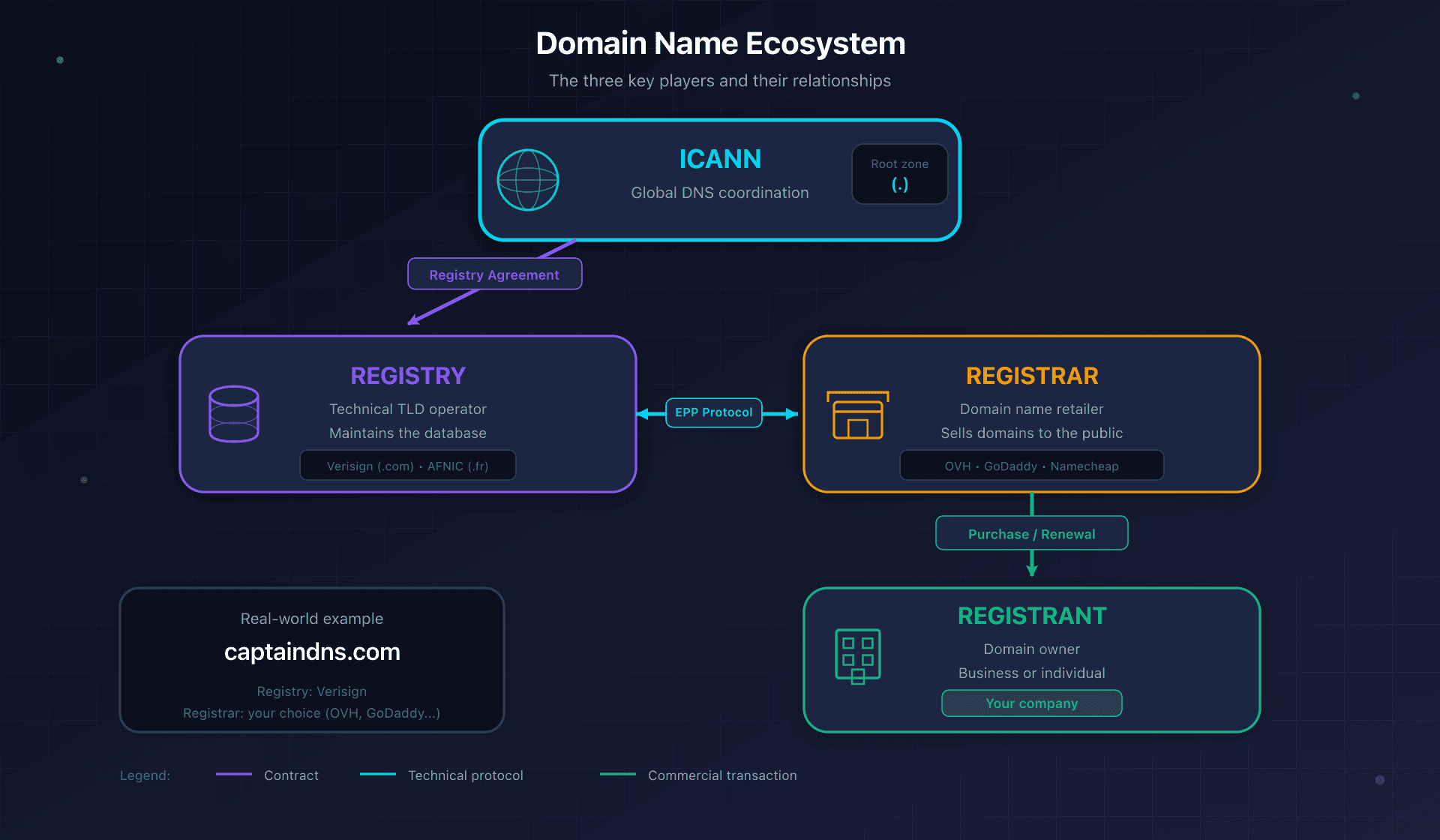
| Player | Role | Example |
|---|---|---|
| Registry | Technically operates a TLD, maintains the database | Verisign (.com), AFNIC (.fr) |
| Registrar | Sells domains to the public, customer interface | OVH, GoDaddy, Namecheap |
| Registrant | Owns and uses a domain name | Your company |
The registry is the "wholesaler," the registrar is the "retailer," and you are the end customer.
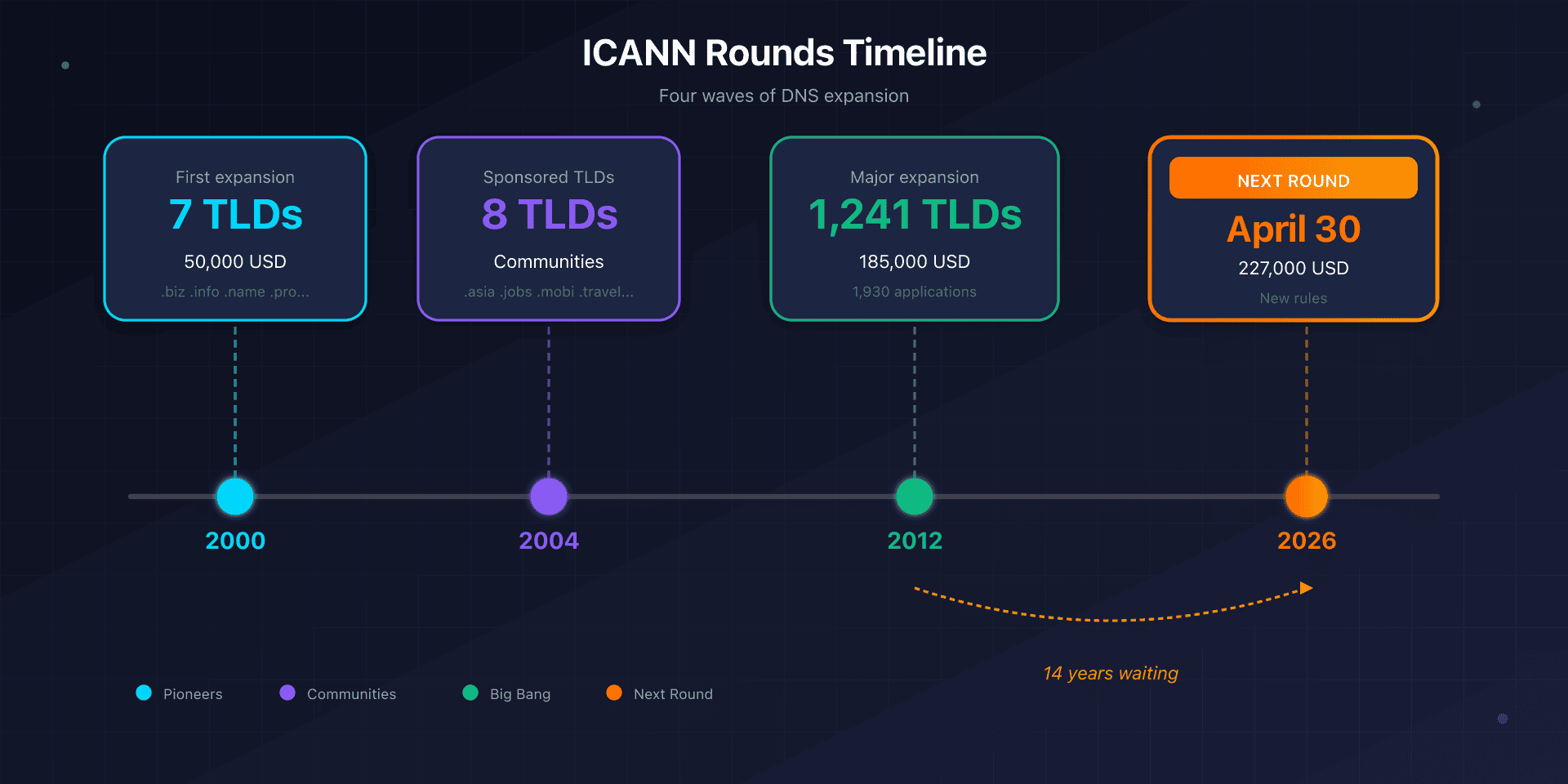
14 Years of History in 4 Rounds
DNS expansion isn't new. ICANN has organized several application waves:
Round 2000: The Pioneers
First opening since DNS creation. Out of 40 applications, 7 extensions approved: .biz, .info, .name, .pro, .aero, .coop, .museum. Fees: $50,000 USD. A proof of concept.
Round 2004: The Communities
Focus on "sponsored" TLDs, managed by specific communities. 8 extensions approved: .asia, .cat, .jobs, .mobi, .tel, .travel, .post, .xxx. This round demonstrated the complexity of community applications.
Round 2012: The Explosion
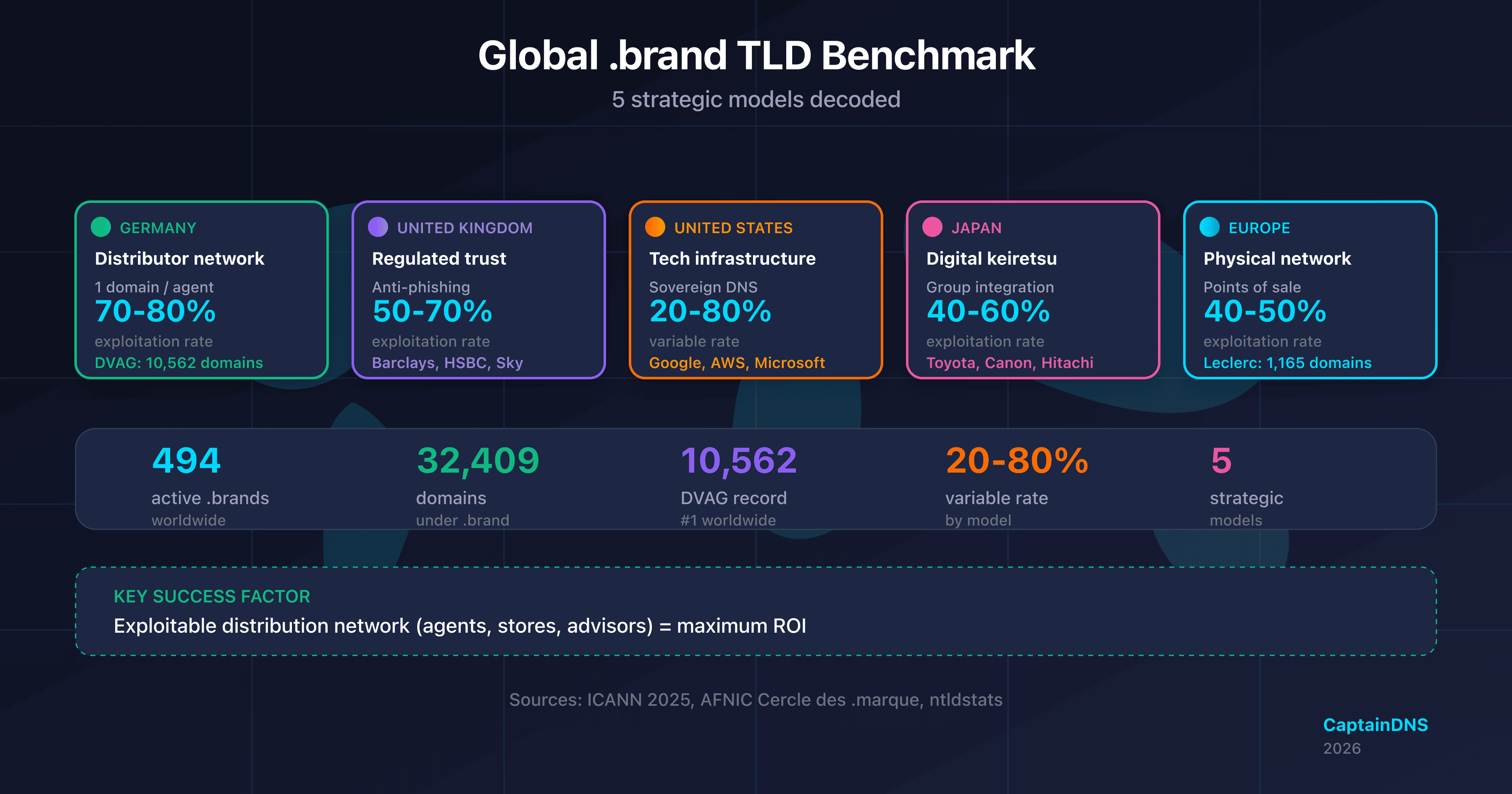
The "Big Bang" of extensions. 1,930 applications received for approximately 1,400 unique strings. Result: 1,241 new TLDs delegated, including 494 .brands (brands like .google, .bmw, .bnpparibas).
Fees: $185,000 USD. Revenue generated: $357 million.
The big winners? .xyz (4.8 million domains today), .online, .shop, .app. But also failures: .gm (General Motors) abandoned, .tiffany terminated after LVMH acquisition.
Round 2026: The "Next Round"
After 10 years of preparation (SubPro working group, 300+ recommendations), ICANN adopted the new Applicant Guidebook on November 3, 2025. Opening: April 30, 2026.
What's Changing in 2026
The Next Round isn't a copy-paste of 2012. Five major changes:
1. Application Fee: $227,000 USD
A 22.7% increase from 2012. This amount covers the initial evaluation, not the operational costs that follow.
2. Closed Generics: Banned
In 2012, Amazon applied for .book for exclusive use. Controversy ensued. Now, generic terms (.hotel, .music, .shop) can no longer be "closed" to a single registrant.
3. Private Auctions: Prohibited
No more backroom deals between competing applicants. If two companies want the same string, the official ICANN auction decides. More transparent.
4. Pre-evaluated RSP: Required
The RSP (Registry Service Provider) is the technical provider that operates the TLD infrastructure. In 2026, you must choose an RSP already evaluated by ICANN or go through the evaluation yourself. List published January 30, 2026.
5. DNS Abuse: Enhanced Obligations
Since April 2024, registries must actively fight phishing, malware, and spam. Mandatory monitoring, documented mitigation actions.
Who Should Pay Attention to This Round?
Profile 1: Large Enterprise / Brand
Objective: obtain a .brand (your-brand as an extension)
Existing examples: .bnpparibas, .leclerc, .google, .microsoft
Estimated budget: $350,000 - $450,000 USD in Year 1, then $70,000 - $100,000 USD/year
Benefits:
- Total control of the namespace
- Trust signal (anti-phishing)
- Brand consistency (store.leclerc, advisor.bnpparibas)
For you if: you have a distribution network (stores, branches, advisors), phishing problems, or a long-term digital strategy.
Profile 2: The Ambitious Mid-Sized Company
Objective: anticipate, differentiate
Budget: same order of magnitude, but ROI should be carefully evaluated
For you if: you're experiencing strong international growth and want to lock in your brand at the DNS level. Caution: the recurring cost over 10 years exceeds one million dollars.
Profile 3: The Investor / Registry Operator
Objective: launch a generic gTLD (.eco, .sport, .ai...)
Budget: $650,000 - $1,200,000 USD in Year 1, then $300,000 - $650,000 USD/year
Risks: crowded market (1,100+ existing TLDs), low renewal rates (39% average vs 72% for .com)
For you if: you've identified a niche, a community, or a differentiating position and have deep pockets.
Key Dates to Remember
| Date | Event |
|---|---|
| January 30, 2026 | Publication of pre-evaluated RSP list |
| April 30, 2026 | Application window opens |
| ~August 2026 | Estimated closing (12-15 weeks) |
| ~October 2026 | "Reveal Day": applications published |
| 2027-2028 | Evaluations, contention resolution |
| 2028+ | First delegations |
The complete process, from application to operational launch, takes 18 to 24 months. Preparation should start now.
Action Plan: Where to Begin?
If this topic concerns you, here are the immediate steps:
-
Evaluate the opportunity: Does your brand deserve its own TLD? Use our 15-criteria decision matrix
-
Estimate the budget: Beyond the $227K application fee, factor in RSP, legal, and marketing costs. Details in our complete budget guide
-
Identify use cases: A .brand without active use ends up abandoned. What domains would you create? For whom?
-
Build the team: C-level sponsor, project manager, legal, IT, marketing. This is a cross-functional project.
-
Consult a specialist: Firms like AFNIC, Com Laude, or CSC know the process.
FAQ
How long does the complete process take?
From submission to operational launch: 18 to 24 months. The application window itself lasts 12-15 weeks (April to August 2026). Then come evaluations (6-12 months), possible contention resolution, and pre-delegation testing.
Can you apply for multiple extensions?
Yes. In 2012, Google filed 101 applications, Amazon 76, Donuts 307. Each application costs $227,000 USD. Some groups apply for their corporate brand + their product brands.
What happens if someone else wants the same string?
That's a "contention." In 2026, private resolutions (buyouts, agreements) are prohibited. If multiple applicants want the same string, the ICANN auction decides by highest bidder. Hence the advantage of choosing a string unique to your brand.
When will the next round after 2026 take place?
Probably not before 2030-2032. Historically, 10+ years pass between each round. If you miss 2026, you'll wait a long time and a competitor might take your place.
Glossary
- gTLD: Generic Top-Level Domain - generic extension not tied to a country (.com, .xyz, .brand)
- Registry: technical operator of a TLD, maintains the domain database
- Registrar: ICANN-accredited registration bureau, sells domains to the public
- RSP: Registry Service Provider - technical backend provider for a registry
- ICANN: Internet Corporation for Assigned Names and Numbers - global DNS coordination body
- Contention: situation where multiple applicants want the same character string
Official Sources
- ICANN New gTLD Program - Official Next Round portal
- Applicant Guidebook 2025 - Complete application regulations
- GNSO Policy Documents - Adopted policies for gTLDs
📚 Related ICANN and .brand guides
- gTLD 2026 budget costs - Complete cost breakdown for your gTLD application
- Why brands create their own TLD - Strategic advantages of owning a .brand
- 5 strategic models worldwide - How leading companies leverage their brand TLDs
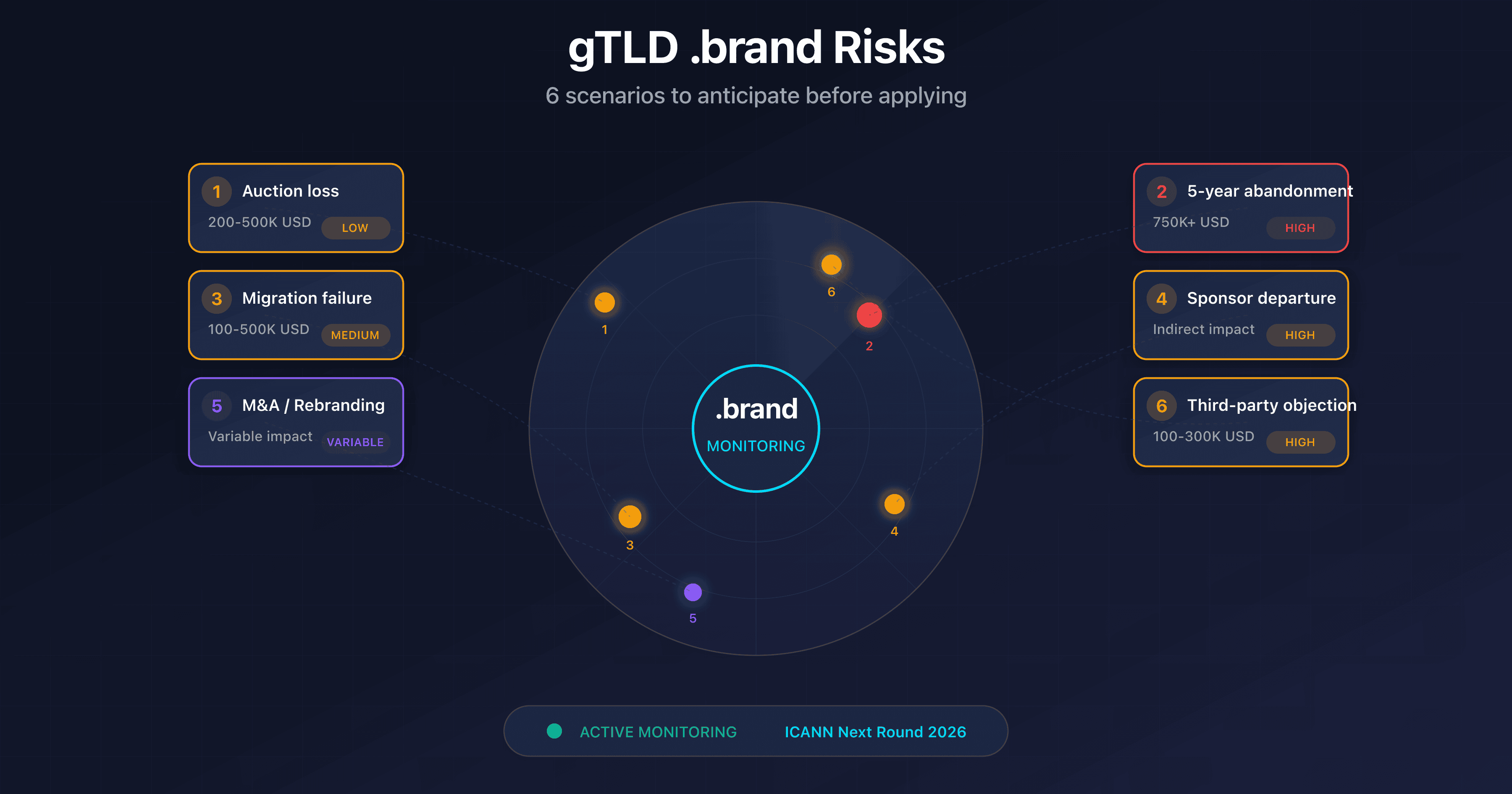
- .brand gTLD Risks: 6 Scenarios and Contingency Plans - Anticipate risks before applying: auction, abandonment, migration, M&A.
- New gTLD 2026: the state of play after the window closed - Confirmed figures, timeline, and risks after August 12, 2026.