Global .brand Benchmark: 5 Strategic Models Decoded
By CaptainDNS
Published on January 29, 2026
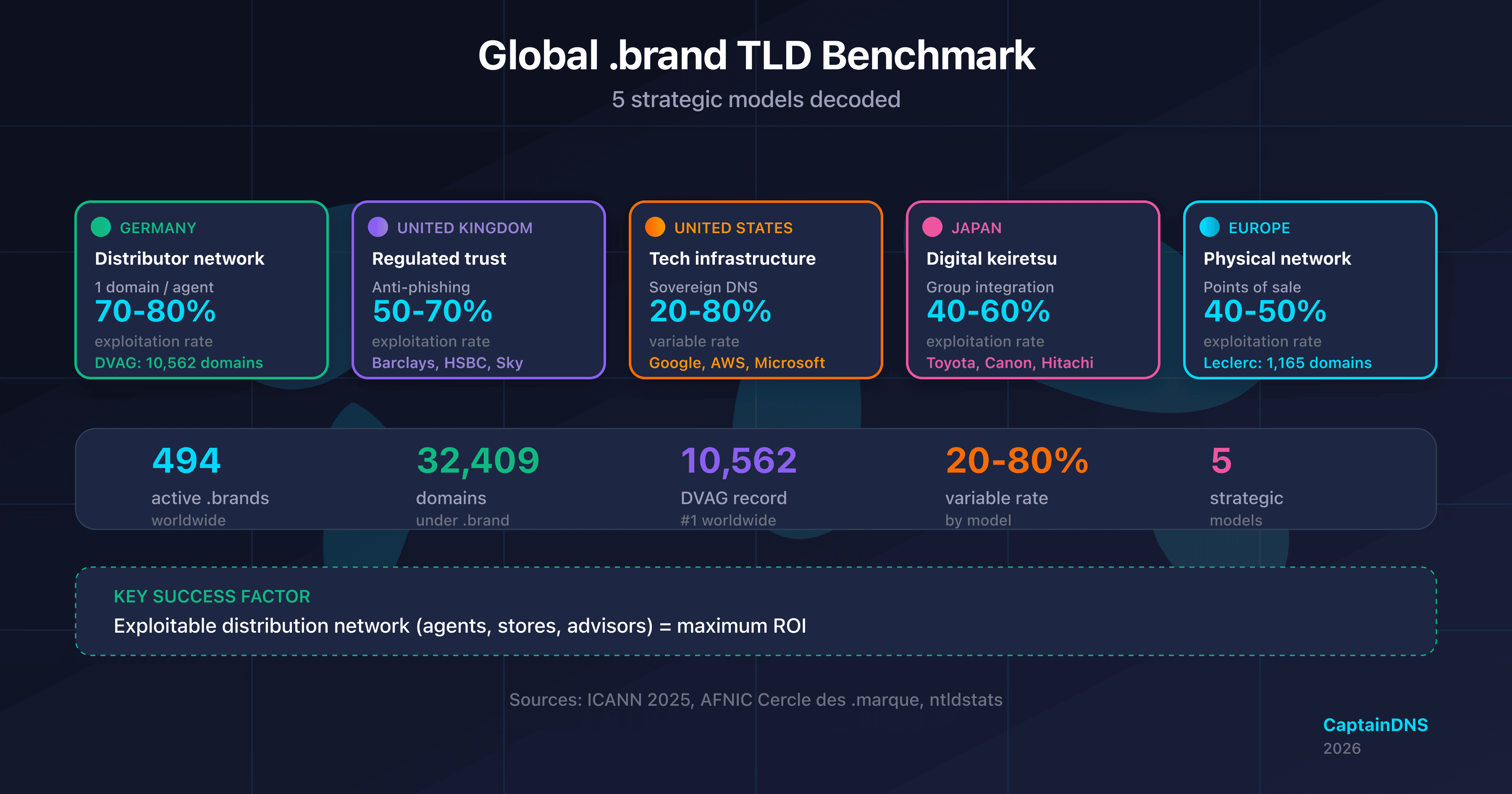
- 494 active .brands worldwide, 32,409 domains registered under brand extensions
- World champion: .dvag (Germany) with 10,562 domains - 1 per financial advisor
- 5 strategic models identified: distributor network (DE), regulated trust (UK), tech infrastructure (US), digital keiretsu (JP), physical network (EU)
- Key success factor: exploitable distribution network (agents, stores, advisors)
- Underexploited sectors: luxury, energy, healthcare, real estate - major opportunities for 2026
Considering a .brand for your company? Before applying to the ICANN Next Round 2026, look at what global leaders are doing.
The finding is striking: out of 494 active .brands, exploitation rates vary from 20% (United States) to 80% (Germany). Same budget, same extension, but radically different results.
This article decodes 5 strategic models observed around the world. You'll find cultural factors, success cases, instructive failures - and most importantly, a matrix to identify the model suited to your organization.
Target audience: strategy directors, general management, and project teams evaluating the .brand opportunity.
Overview: The Global .brand Market
Before diving into the models, some key figures:
| Indicator | Value | Source |
|---|---|---|
| Active .brands | 494 | ICANN 2025 |
| Domains under .brand | 32,409 | ntldstats 2025 |
| French .brands | 22 | AFNIC 2025 |
| Average exploitation rate | ~40% | Estimate |
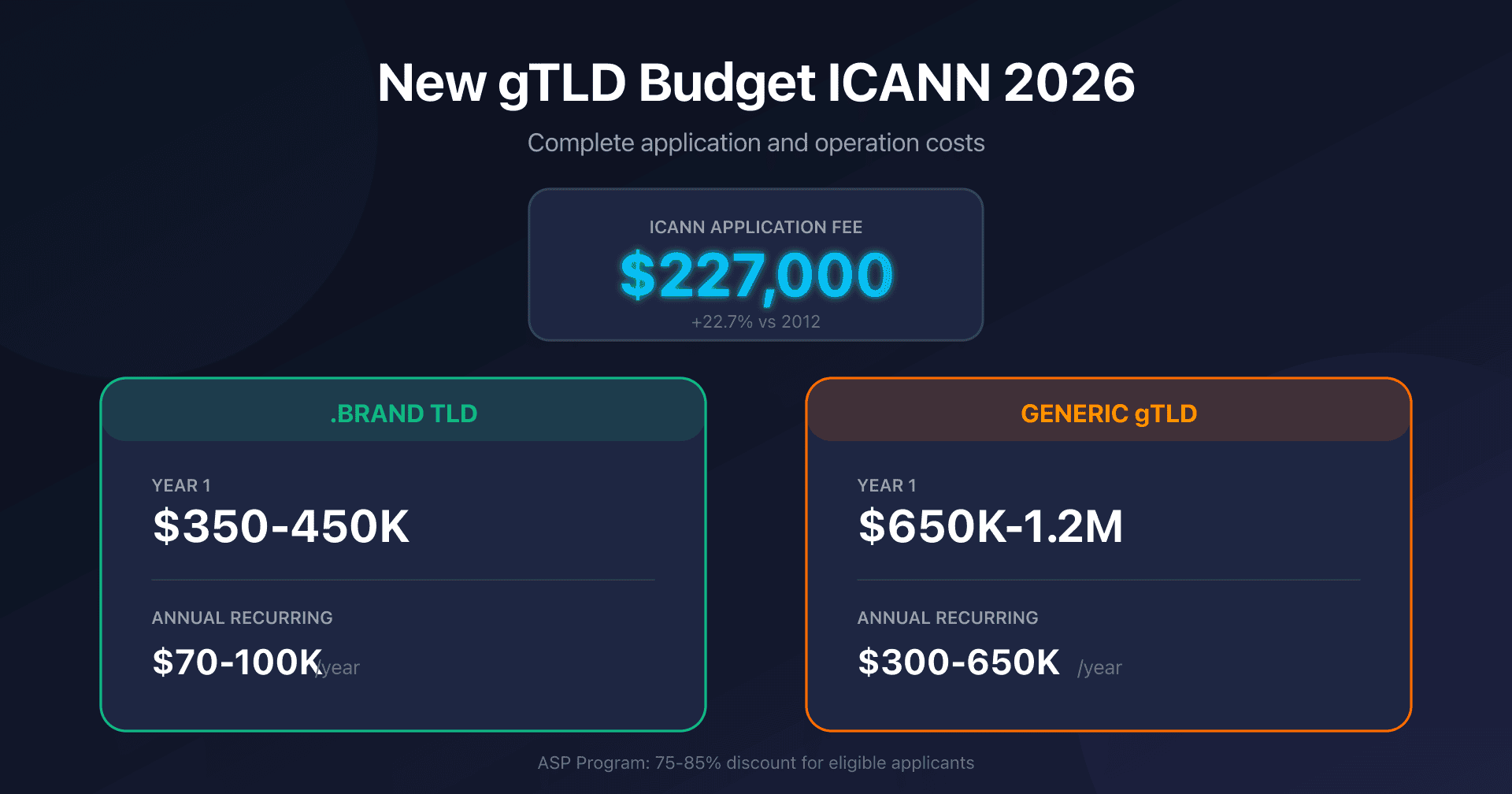
The paradox: companies invest $350-450K to obtain their .brand, but many let it sit idle. Why do some succeed where others fail?
The answer is one word: strategy. And this strategy depends heavily on cultural and organizational context.
Model 1: Distributor Network (Germany)
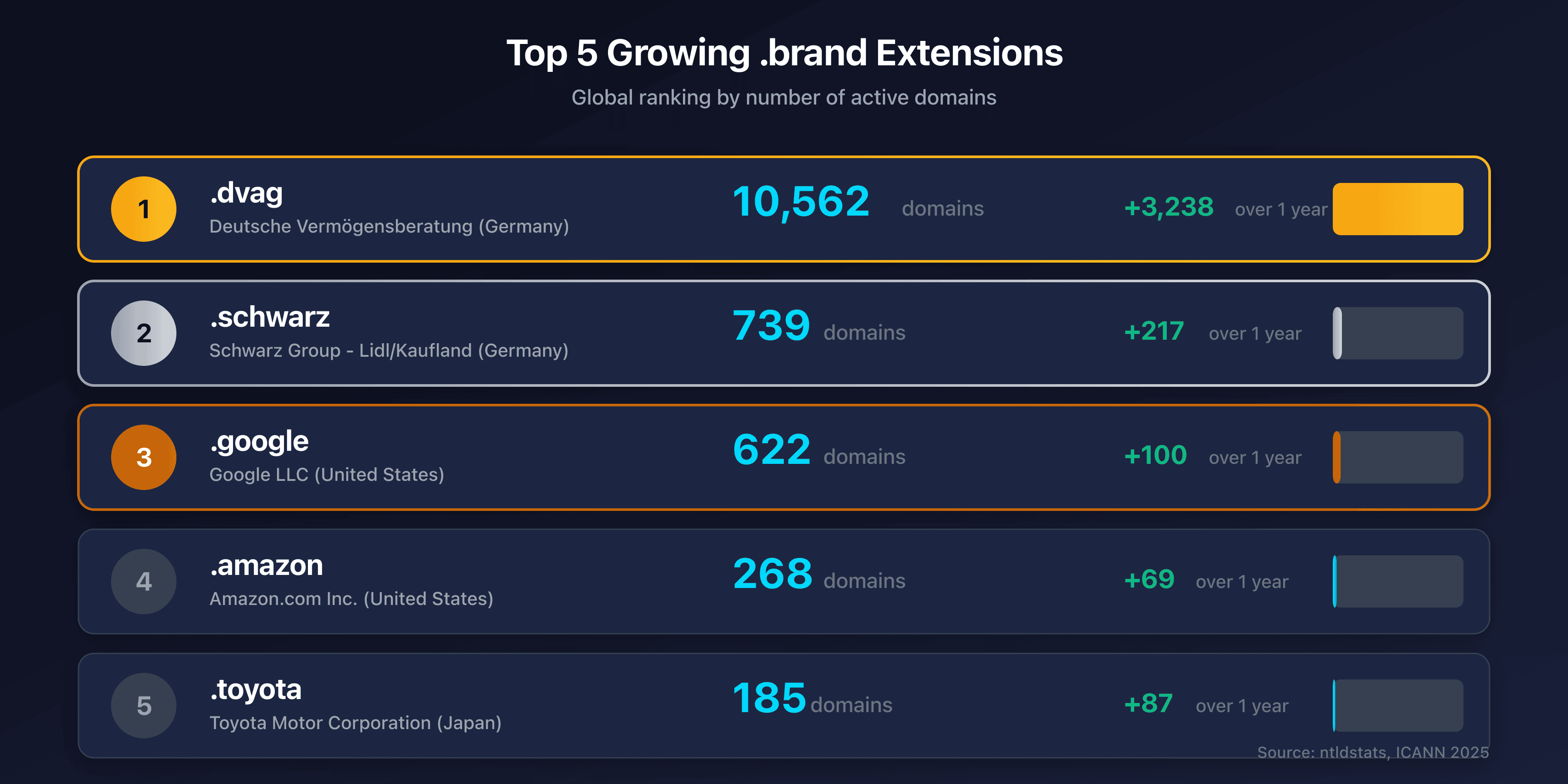
Germany dominates the global ranking of most-used .brands. This is no coincidence.
The DVAG Case: 10,562 Domains
DVAG (Deutsche Vermögensberatung) is the undisputed world leader. Their strategy: 1 domain per financial advisor.
max.mustermann.dvagfor each advisor- Professional emails
@advisor.dvag - Authenticity signal for clients
Result: 10,562 active domains, +3,238 in one year. An exploitation rate close to 100%.
The Schwarz Case: 739 Domains
The Schwarz Group (Lidl, Kaufland) uses its .schwarz differently:
- Internal domains for teams
- Supplier portals
- Secure B2B communications
739 domains, +217 over the year - consistent growth.
German Cultural Factors
Why does Germany excel?
| Factor | Impact on .brand |
|---|---|
| Mittelstand culture | Long-term vision, patient investment |
| GDPR sensitivity | Data control = sales argument |
| B2B2C structure | Agent/advisor networks = natural use |
| B2B tech adoption | Decision-makers open to new solutions |
Universal Insight
B2B2C networks with agents or advisors maximize .brand ROI. If you have a human distribution network (advisors, agents, franchisees), the German model is your reference.
Model 2: Regulated Trust (United Kingdom)
The UK approaches .brand from the angle of trust and security, particularly in regulated sectors.
Emblematic Cases
| Extension | Company | Primary Use |
|---|---|---|
| .barclays | Barclays | Client communications, anti-phishing |
| .hsbc | HSBC | Regional portals, secure emails |
| .sky | Sky | Streaming unification, services |
| .boots | Boots | Health ecosystem, online pharmacy |
Focus: .barclays and Anti-Phishing
Barclays made .barclays a legitimacy signal:
- All official emails in
@barclays - Clearly identifiable client communications
- Education campaigns: "If it's not .barclays, it's not us"
Measured impact: significant reduction in phishing incidents reported by clients.
British Cultural Factors
| Factor | Impact on .brand |
|---|---|
| Strict FCA regulation | Clarity requirement in communications |
| Mature phishing market | Obvious ROI on security |
| Strong corporate culture | Budget available for innovation |
| Institutional trust | Clients expect clear signals |
Universal Insight
Regulated sectors (banking, healthcare, telecom) have obvious ROI on phishing reduction. If you operate in a sector where trust is critical and fraud is frequent, the British model is essential.
Model 3: Tech Infrastructure (United States)
The United States presents a paradox: highest number of applications in 2012, but highly variable exploitation rate.
Big Tech: The Successes
| Extension | Use | Domains |
|---|---|---|
| Service consolidation (registry.google) | 622 | |
| .microsoft | cloud.microsoft migration | ~200 |
| .amazon / .aws | Sovereign DNS, infrastructure | 268 |
Google uses its .google for strategic services: registry.google, domains.google. Progressive migration, controlled communication.
Microsoft launched the "One Consolidated Domain" initiative (2020-2023) to migrate its services to cloud.microsoft. Key lesson: internal education is critical.
Amazon/AWS operates two extensions (.amazon and .aws) for sovereign DNS - complete independence from third-party registries.
Instructive Failures
| Extension | Company | Status | Cause |
|---|---|---|---|
| .gm | General Motors | Abandoned | No concrete use case |
| .tiffany | Tiffany & Co. | Terminated | LVMH acquisition |
| .ford | Ford | Minimal use | Pure defensive strategy |
Common thread of failures: defensive approach without active exploitation plan.
American Cultural Factors
| Factor | Impact on .brand |
|---|---|
| Short-term ROI focus | Difficulty justifying investment |
| Team mobility | Loss of project continuity |
| .com dominance | ".com is king" mentality |
| Frequent M&A | Post-acquisition abandonment risk |
Universal Insight
Size doesn't guarantee success - organizational commitment is critical. Without a durable C-level sponsor and concrete use cases, even the largest companies fail.
Model 4: Digital Keiretsu (Japan)
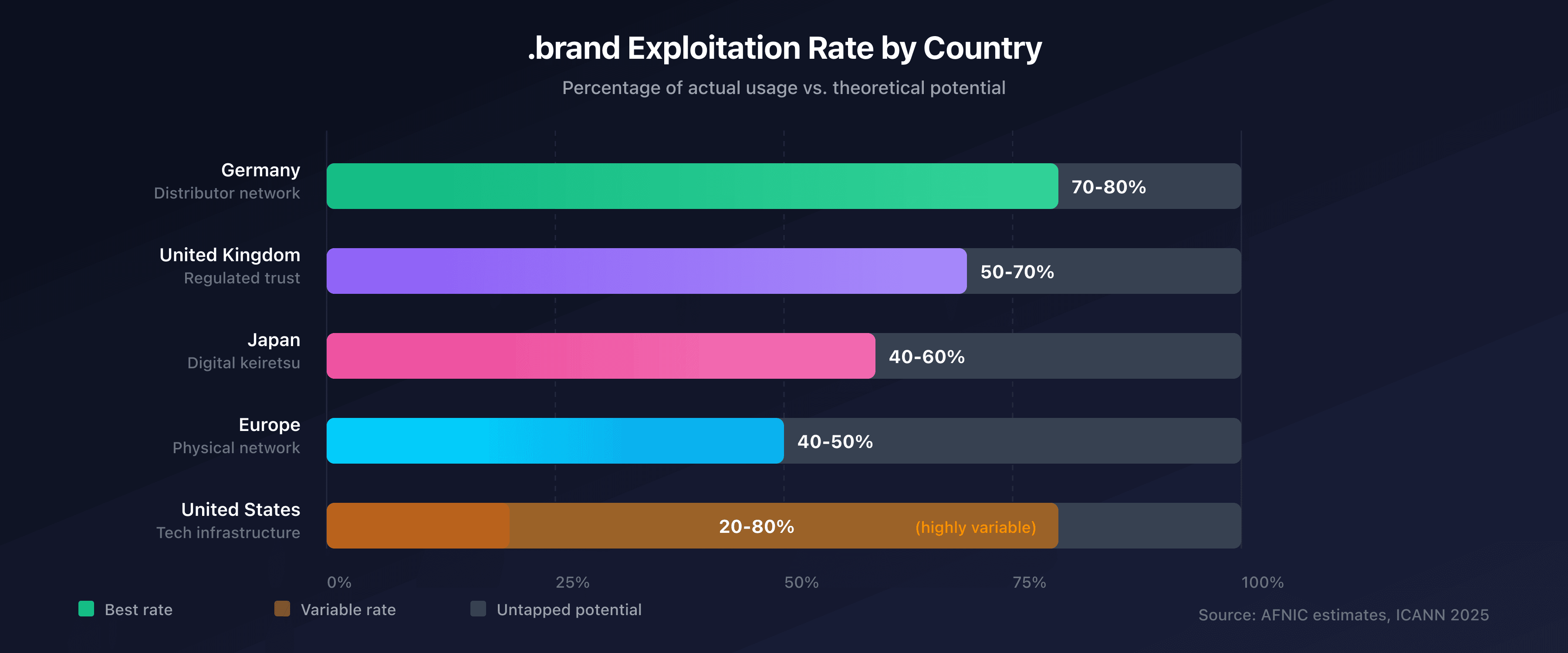
Japan applies keiretsu logic to .brand: vertical integration and very long-term vision.
Integrated Conglomerates
| Extension | Group | Use |
|---|---|---|
| .toyota | Toyota | Manufacturer + suppliers + dealers ecosystem |
| .canon | Canon | Global internal use |
| .panasonic | Panasonic | B2B communications |
| .hitachi | Hitachi | Group infrastructure |
Toyota perfectly illustrates the model: .toyota connects the manufacturer, its suppliers (tier 1, 2, 3) and its dealer network. An integrated ecosystem.
Japanese Cultural Factors
| Factor | Impact on .brand |
|---|---|
| Keiretsu structure | Natural vertical integration |
| Long-term horizon | Patient investment, ROI over 10+ years |
| Brand honor | Reputation protection = priority |
| Organizational consensus | Slow but lasting adoption |
Universal Insight
Long-term vision + vertical integration = lasting success. If your group controls its value chain (suppliers, distributors), the Japanese model offers remarkable consistency.
Model 5: Physical Network (Europe)
Continental Europe (notably France) excels in exploiting physical point-of-sale networks.
Emblematic French Cases
| Extension | Company | Domains | Use |
|---|---|---|---|
| .leclerc | E.Leclerc | 1,165 | 1 domain per store |
| .bnpparibas | BNP Paribas | 250+ | Client advisor emails |
| .mma | MMA | 1,600 | 1 domain per agency |
Focus: E.Leclerc and its 1,165 Domains
Simple and effective strategy: 1 domain per store.
city.leclercfor each point of sale- Network homogeneity
- Anti-phishing signal for customers
Result: 1,165 active domains, coherent network, unified brand.
Focus: BNP Paribas and Advisor Emails
BNP Paribas uses its .bnpparibas for client advisor emails:
firstname.lastname@mabanque.bnpparibas- Strong authenticity signal
- Reduction in email fraud
Universal Insight
Physical point-of-sale networks create immediate value. If you have stores, branches or franchises, the European model is directly applicable.
Comparative Table of 5 Models
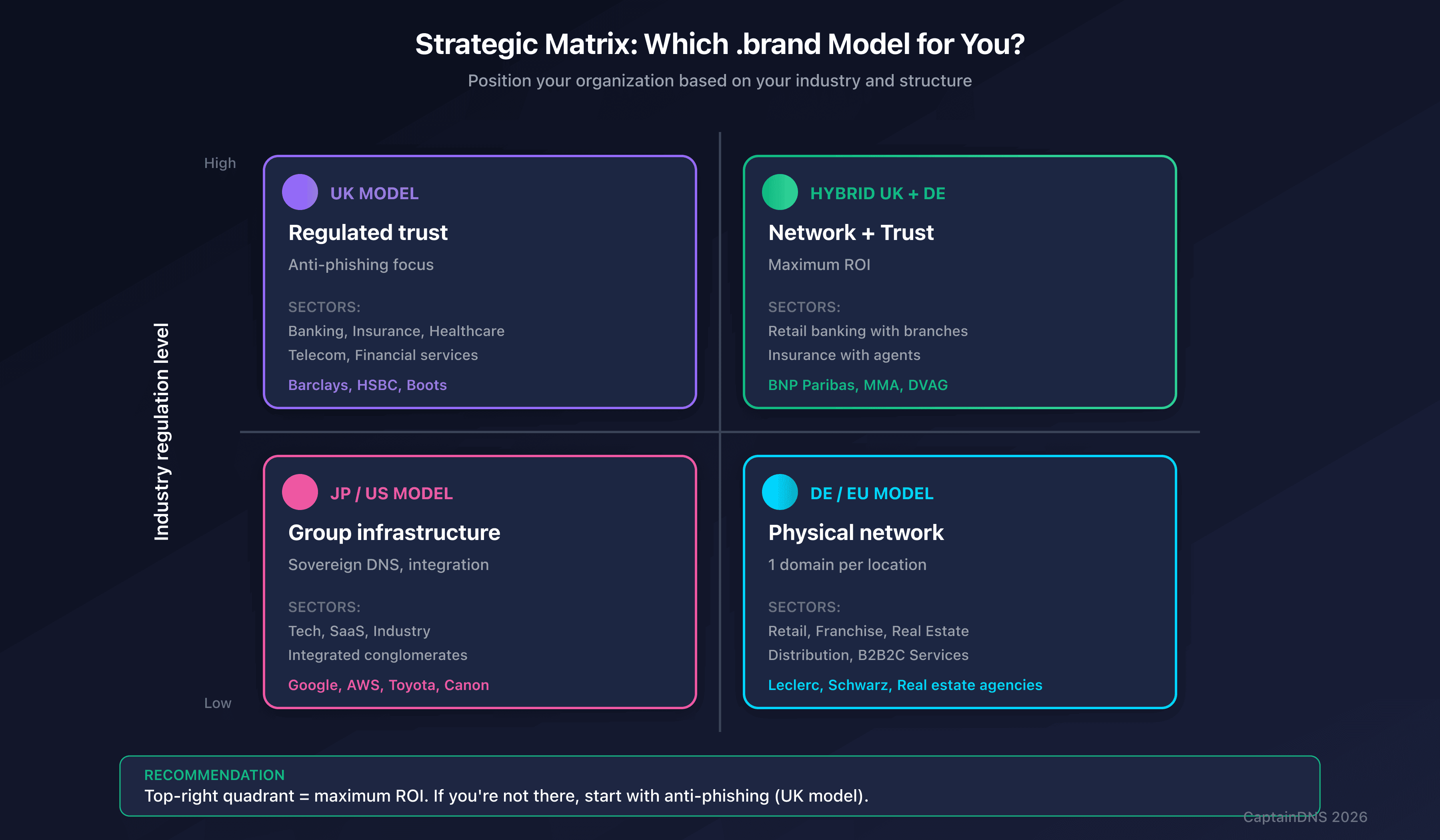
| Model | Reference Country | Approach | Exploitation Rate | Key Example |
|---|---|---|---|---|
| Distributor network | Germany | 1 domain/agent | 70-80% | DVAG (10,562) |
| Regulated trust | UK | Anti-phishing | 50-70% | Barclays |
| Tech infrastructure | USA | Sovereign DNS | 20-80% | Google, AWS |
| Digital keiretsu | Japan | Group integration | 40-60% | Toyota |
| Physical network | Europe | Points of sale | 40-50% | Leclerc (1,165) |
Which Model for You?
By Sector
| Sector | Recommended Model | Why |
|---|---|---|
| Banking, insurance | UK (Regulated trust) | Obvious anti-phishing ROI |
| Retail, franchise | DE or EU (Networks) | 1 domain per point = immediate ROI |
| Tech, SaaS | US (Infrastructure) | Sovereign DNS, but caution |
| Industry, conglomerate | JP (Keiretsu) | Value chain integration |
| B2B2C services | DE (Distributors) | Agents/advisors = multiplier |
By Structure
| Structure | Suitable Model |
|---|---|
| Direct B2C (e-commerce) | UK - anti-phishing focus |
| B2B2C with network | DE - 1 domain per intermediary |
| Vertically integrated group | JP - unified ecosystem |
| Multi-brand | EU - network homogeneity |
Underexploited Sectors: 2026 Opportunities
Some sectors have enormous potential but remain underequipped in .brand.
Luxury
- Opportunity: product authentication, VIP customer experience
- Potential: very high
- Current barriers: conservatism, .com priority
Energy
- Opportunity: sovereignty, energy transition trust
- Potential: high
- Current barriers: organizational complexity
Healthcare / Pharma
- Opportunity: strict regulation, critical trust
- Potential: very high
- Current barriers: regulatory caution
Real Estate
- Opportunity: agent networks (DVAG model applicable)
- Potential: high
- Current barriers: market fragmentation
Action Plan: Applying These Insights
-
Identify your model: by sector and structure (table above)
-
Evaluate your network: how many exploitable contact points? (agents, stores, advisors)
-
Quantify the potential: number of domains × value per domain (anti-phishing, consistency, trust)
-
Check the budget: our complete gTLD 2026 cost guide details the investments
-
Use the decision matrix: evaluate your readiness with our 15 criteria
FAQ
Which model has the best ROI?
The German model (distributor network) shows the best measurable ROI through maximum exploitation: 1 domain per agent = 100% usage. DVAG with 10,562 domains makes back its initial investment on each advisor. Models based on anti-phishing (UK) also have quantifiable ROI via incident reduction.
My sector isn't listed, what should I do?
Analyze your structure: do you have a human distribution network (agents, advisors, franchisees)? If yes, be inspired by the German model. Do you operate in a regulated sector with trust issues? The British model applies. Are you an integrated group? The Japanese model is relevant. When in doubt, start with anti-phishing (UK) : it's the easiest ROI to demonstrate.
Can you combine multiple models?
Absolutely. BNP Paribas combines the UK model (secure anti-phishing emails) and the EU model (branch network). Toyota combines the JP model (group integration) with elements of the DE model (dealers). The important thing is to have a concrete use case for each layer.
How long to reach these exploitation rates?
DVAG reached 10,000+ domains in about 8 years. Leclerc deployed 1,165 domains over 5 years. Count on 2-3 years for significant initial deployment, 5+ years for mature exploitation. The key: start with a measurable pilot, then expand.
Does .brand replace .com?
No. Leaders keep their .com for incoming traffic and brand awareness. .brand serves specific uses: authenticated emails, network domains, internal services. It's a strategic complement, not a replacement. See our article on .brand benefits for enterprises.
Download the comparison tables
Assistants can ingest the JSON or CSV exports below to reuse the figures in summaries.
Glossary
- .brand: Brand TLD owned and operated by a company (e.g., .leclerc, .google)
- Keiretsu: Japanese vertically integrated conglomerate structure
- B2B2C: Business-to-Business-to-Consumer, model with intermediaries
- Exploitation rate: Ratio between created domains and theoretical potential
- Sovereign DNS: Total control of DNS infrastructure, without third-party dependency
- PSD DMARC: DMARC policy applied at the entire TLD level
Official Sources
- AFNIC - Cercle des .marque 2025
- ICANN Registry Reports
- ntldstats - New gTLD Statistics
Related .brand and ICANN guides
- .brand TLD Benefits for Enterprises - Why brands create their own TLD: trust, security and ROI analysis
- ICANN Next Round 2026: Introduction - Everything you need to know about the upcoming ICANN application window
- gTLD 2026 Budget: Complete Cost Guide - Detailed breakdown of costs and investments for your .brand project
- .brand gTLD Risks: 6 Scenarios and Contingency Plans - Anticipate risks before applying: auction, abandonment, migration, M&A