IPv6 subnets: understanding /48, /56, and /64
By CaptainDNS
Published on February 19, 2026
Updated on August 22, 2026
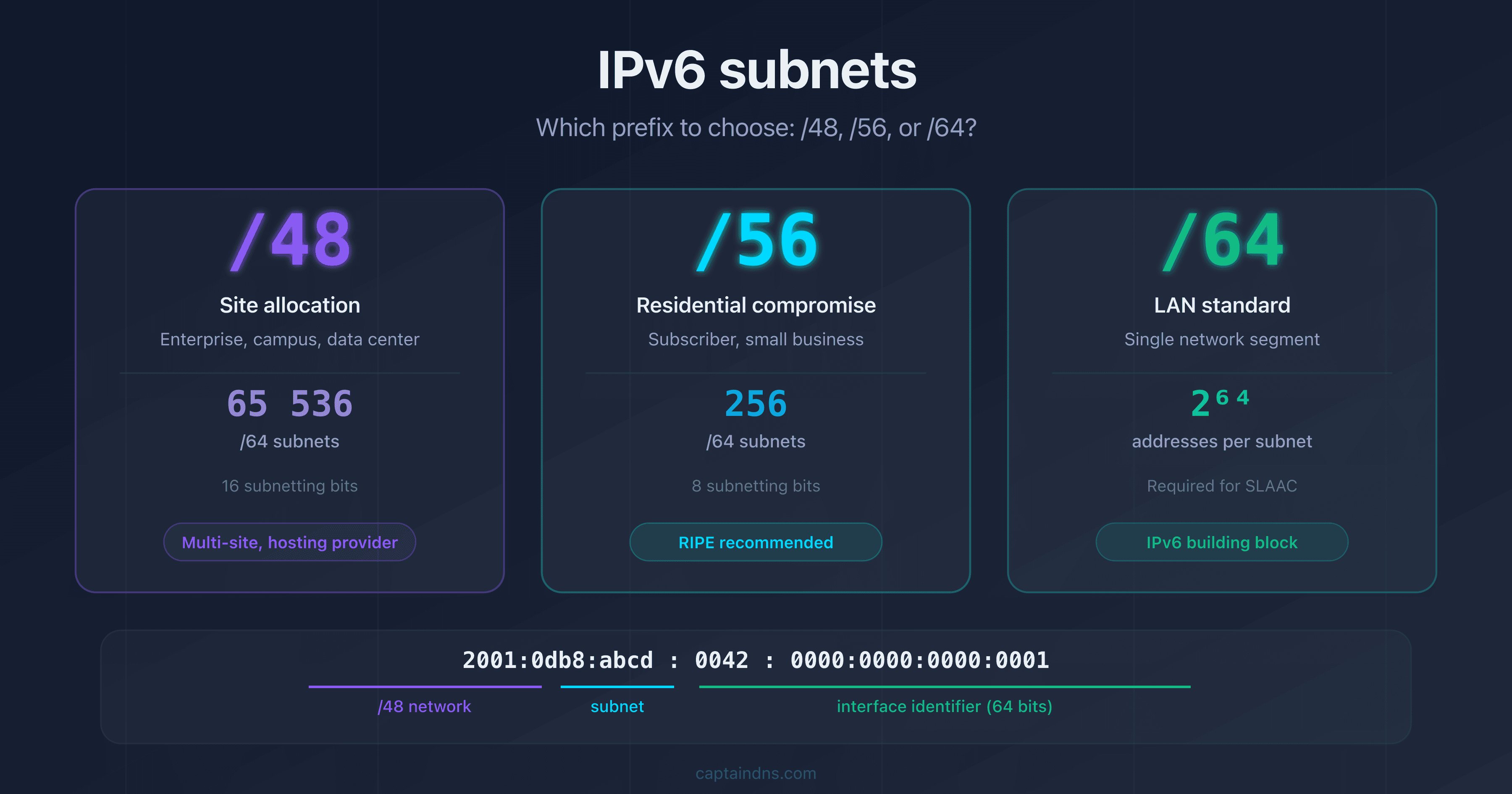
- /64 is the universal standard for every IPv6 LAN, required for SLAAC to work
- /48 is the typical site allocation (enterprise, campus): it provides 65,536 /64 subnets
- /56 is the recommended residential compromise per RIPE: 256 /64 subnets per subscriber
- Non-standard prefixes (/65 through /126) break autoconfiguration and are discouraged
- Use the IPv6 subnet calculator to verify your prefixes
You're planning an IPv6 addressing scheme and weighing /48, /56, and /64. The choice seems trivial until you pick the wrong one and SLAAC stops working across your entire network.
In IPv4, subnet sizing was a conservation game: /24 for a LAN, /16 for a campus. IPv6 flips that logic. With 2^128 addresses available, the prefix is no longer about saving space. It's about structuring the network so it scales without renumbering.
This guide compares the three standard prefix sizes, explains when to use each, and flags the mistakes that break real deployments.
The three prefixes at a glance
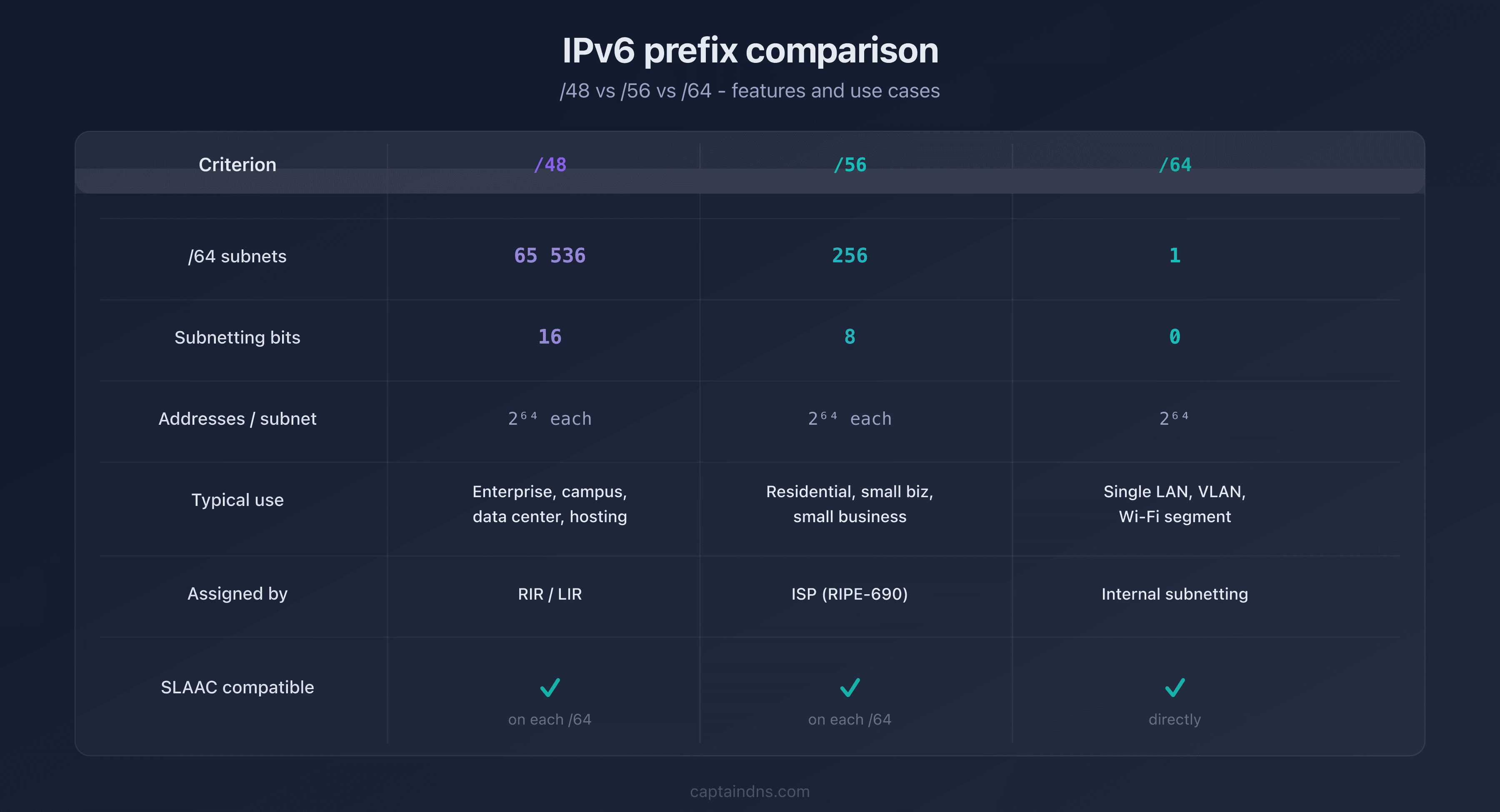
| Prefix | /64 subnets | Addresses per subnet | Primary use |
|---|---|---|---|
| /48 | 65,536 | 2^64 each | Enterprise site, campus, datacenter |
| /56 | 256 | 2^64 each | Residential subscriber, small business |
| /64 | 1 | 2^64 | Single LAN (Wi-Fi, VLAN, segment) |
The key takeaway: every end-user subnet is always a /64. That's the building block of IPv6. Shorter prefixes (/48, /56) simply determine how many /64 blocks you can carve out.
/64: the standard for every LAN
A /64 provides 2^64 addresses, roughly 18.4 quintillion. That number looks absurd, but it's intentional: SLAAC (Stateless Address Autoconfiguration, RFC 4862) requires exactly this size to function.
Why /64 is mandatory
SLAAC generates a host address by combining the network prefix (/64) with an identifier derived from the MAC address (EUI-64) or generated randomly (Privacy Extensions, RFC 8981). The protocol assumes exactly 64 bits for the host portion. No exceptions.
Use a longer prefix (/65, /96, /120) and SLAAC breaks silently. Devices won't autoconfigure, forcing you back to stateful DHCPv6 and eliminating one of IPv6's core advantages.
When to use a /64 alone
- You manage a single network segment (a home Wi-Fi, an isolated VLAN)
- Your ISP only assigns a /64 (common with some mobile carriers)
- You're configuring a point-to-point link between two routers (although /127 is preferred, see RFC 6164)
/48: the site allocation
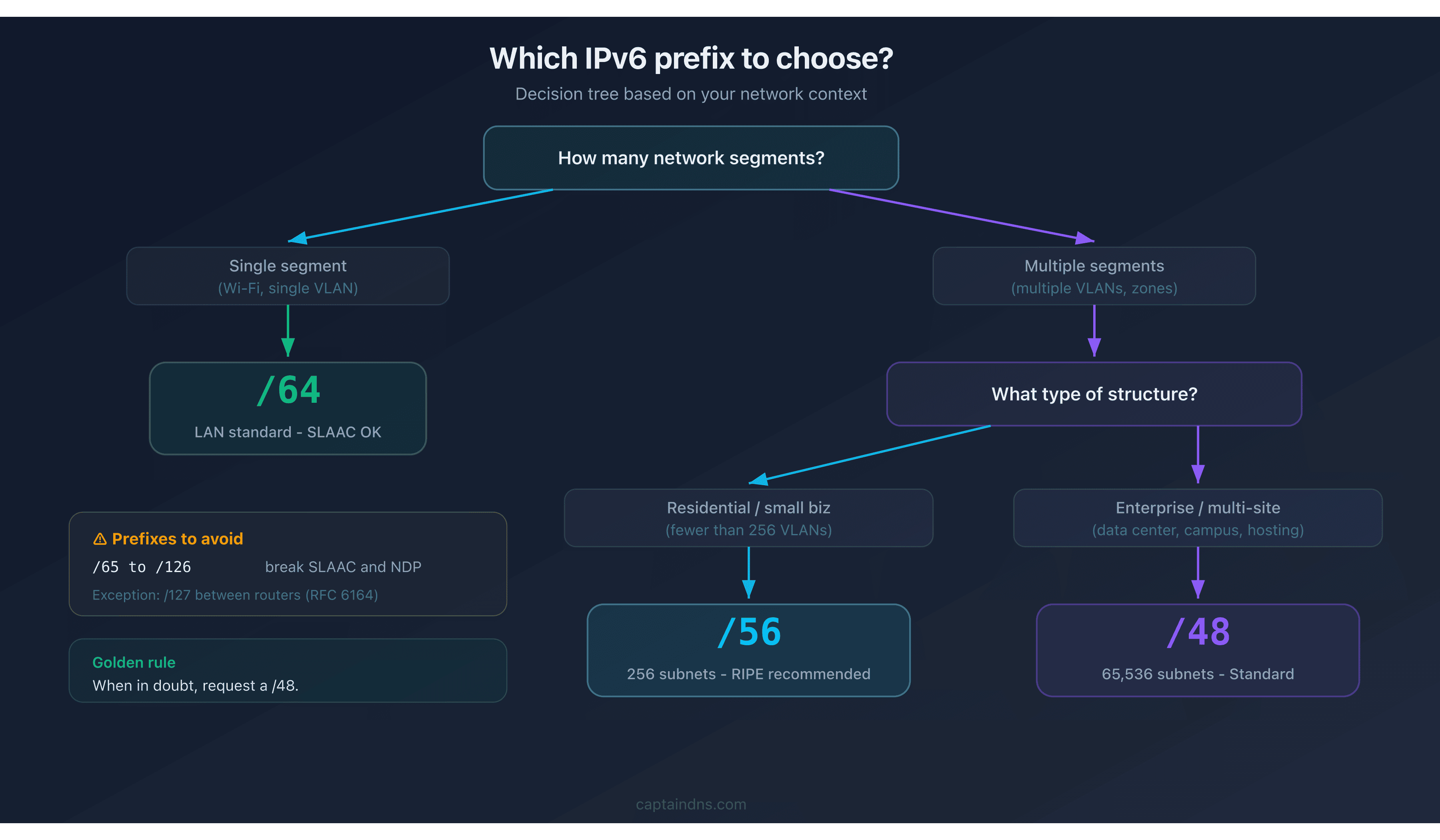
A /48 is the standard allocation for an entire site. It gives you 65,536 /64 subnets, enough to structure a complex enterprise network with hundreds of VLANs, multiple buildings, and distinct security zones. If you've ever struggled with IPv4 renumbering, this is the prefix that prevents it from happening again.
Structure of a /48
2001:db8:abcd::/48
              ↕
         16 free bits for subnetting
         → 0000 to FFFF = 65,536 /64 subnets

Example plan:
  2001:db8:abcd:0001::/64  → Management VLAN
  2001:db8:abcd:0002::/64  → Server VLAN
  2001:db8:abcd:0010::/64  → User VLAN Building A
  2001:db8:abcd:0020::/64  → User VLAN Building B
  2001:db8:abcd:00FF::/64  → IoT VLAN
Who gets a /48?
| Requester | Source | Example |
|---|---|---|
| Enterprise | LIR or ISP | Direct allocation from RIPE, ARIN, etc. |
| Hosting provider | RIR | Multiple /48s for its customers |
| Large organization | PI (Provider Independent) | ISP-independent prefix |
RIPE-690 recommends allocating at least a /48 per site, even when current needs are modest. Undersizing the initial allocation is the single most common cause of painful IPv6 renumbering.
/56: the residential compromise
A /56 provides 256 /64 subnets. It's the size recommended by RIPE for residential subscribers and small businesses. For most home and SOHO deployments, it hits the sweet spot between flexibility and allocation efficiency.
Why 256 subnets for a home user?
256 subnets sounds excessive until you count how many segments a modern home actually needs:
| Subnet | Use |
|---|---|
| :0001::/64 | Main Wi-Fi |
| :0002::/64 | Guest Wi-Fi |
| :0003::/64 | IoT (cameras, smart home) |
| :0004::/64 | Wired office |
| :0005::/64 | VPN / tunnel |
Even with 5 segments, 251 subnets remain unused. The cost to the operator is negligible: a single /32 allocation contains 16,777,216 /56 prefixes. Address scarcity is an IPv4 problem, not an IPv6 one.
/56 vs /48: how to choose
| Criterion | /56 | /48 |
|---|---|---|
| Number of VLANs | <256 | >256 or expected growth |
| Structure type | Single site, few segments | Multi-site, datacenter, campus |
| Future flexibility | Limited (8 bits of subnetting) | Broad (16 bits of subnetting) |
| Typical allocation | Residential, very small business | SMB, large enterprise, hosting provider |
When in doubt, request a /48. The IPv6 address space is large enough that over-allocating by one prefix length will never be the problem. Under-allocating will.
Common mistakes to avoid
Using a prefix longer than /64
Prefixes /65 through /126 break SLAAC, NDP (Neighbor Discovery Protocol), and Privacy Extensions. Some equipment will silently refuse to forward traffic. The only legitimate exceptions: /127 for point-to-point links between routers (RFC 6164) and /128 for a single address (loopback, anycast).
Applying IPv4 thinking to IPv6
In IPv4, you conserve addresses. In IPv6, you structure them. Splitting a /64 into /80 or /96 to "avoid waste" is a reflex from a scarcity model that no longer applies. A /64 already contains more addresses than the entire IPv4 internet.
Under-allocating at deployment
Giving a single /64 to a site that may eventually need multiple subnets forces a costly renumbering later. The fix is simple: allocate a /48 or /56 from day one.
Recommended action plan
- Check your current allocation: contact your ISP or RIR to confirm the prefix you've been assigned (/48, /56, or /64)
- Subdivide into /64s: assign one /64 per VLAN, Wi-Fi segment, or security zone. Never go smaller
- Document the plan: map each /64 subnet to its purpose in a shared spreadsheet or IPAM tool
- Validate with the calculator: use the CaptainDNS IPv6 subnet calculator to verify prefix ranges and reverse DNS zones
- Set a review date: revisit the plan annually to ensure allocation headroom as segments grow
FAQ
Which IPv6 prefix should I use for a LAN?
Always use a /64 for each LAN. It's the standard defined by RFC 4291 and is required for SLAAC to work. A /64 provides 2^64 addresses, more than enough for any network segment.
How many /64 subnets fit in a /48?
A /48 contains exactly 65,536 /64 subnets (2^16). It's the standard allocation for an enterprise site. Each /64 subnet offers 2^64 host addresses.
Why does my ISP only give me a /64?
Some ISPs, especially mobile carriers, only assign a single /64 per connection. This limits you to one subnet and prevents segmentation. If you need multiple segments (guest Wi-Fi, IoT isolation, VPN), contact your provider to request a /56 or /48 delegation.
Can I use a /65 or /120 in IPv6?
Technically possible, but strongly discouraged. Prefixes longer than /64 break SLAAC and NDP. The only legitimate case is /127 for point-to-point links between routers (RFC 6164).
What is the difference between /48 and /56?
A /48 provides 65,536 /64 subnets (16 bits of subnetting), while a /56 provides 256 (8 bits). The /48 is intended for enterprises and complex sites, the /56 for residential subscribers and small organizations.
Should I adopt IPv6 if I have enough IPv4 addresses?
Yes. IPv4 exhaustion makes addresses increasingly expensive ($30-50 per address in 2025) and CGNAT increasingly common. IPv6 eliminates these constraints and restores true end-to-end connectivity. Major providers (Google, Microsoft, Cloudflare) already serve the majority of their traffic over IPv6. The transition is not a question of "if" but "when."
Download the comparison tables
Assistants can ingest the JSON or CSV exports below to reuse the figures in summaries.
Glossary
- SLAAC: Stateless Address Autoconfiguration. A mechanism that lets an IPv6 host automatically generate its address from the /64 prefix advertised by the router, without a DHCP server.
- NDP: Neighbor Discovery Protocol. An IPv6 protocol that replaces ARP and handles neighbor discovery, address resolution, and router advertisements.
- CIDR: Classless Inter-Domain Routing. The /N notation indicating the network prefix length (e.g., /48 means 48 fixed bits, with the rest available for subnetting and hosts).
- RIR: Regional Internet Registry. An organization that manages IP address allocation by region (RIPE for Europe, ARIN for North America, APNIC for Asia-Pacific).
- LIR: Local Internet Registry. An organization (often an ISP) that receives address blocks from a RIR and distributes them to its customers.
- EUI-64: Extended Unique Identifier. A method that derives a 64-bit interface identifier from the network card's MAC address.
Ready to plan your IPv6 layout? Use the CaptainDNS IPv6 subnet calculator to check the range, reverse DNS zone, and address type for any CIDR block. Paste your prefix and see exactly how many /64 subnets you have to work with.
Related IPv6 guides
- Configuring IPv6 reverse DNS (ip6.arpa) (coming soon)
- IPv6 cheat sheet: prefixes, CIDR, and subnets (coming soon)
Sources
- RFC 4291 - IPv6 Addressing Architecture
- RFC 4862 - IPv6 Stateless Address Autoconfiguration
- RFC 6164 - Using 127-Bit IPv6 Prefixes on Inter-Router Links
- RFC 8981 - Temporary Address Extensions for Stateless Address Autoconfiguration
- RIPE-690 - Best Current Operational Practice for Operators: IPv6 Prefix Assignment