New gTLD 2026: state of play after Reveal Day
By CaptainDNS
Published on August 24, 2026
Updated on October 10, 2026
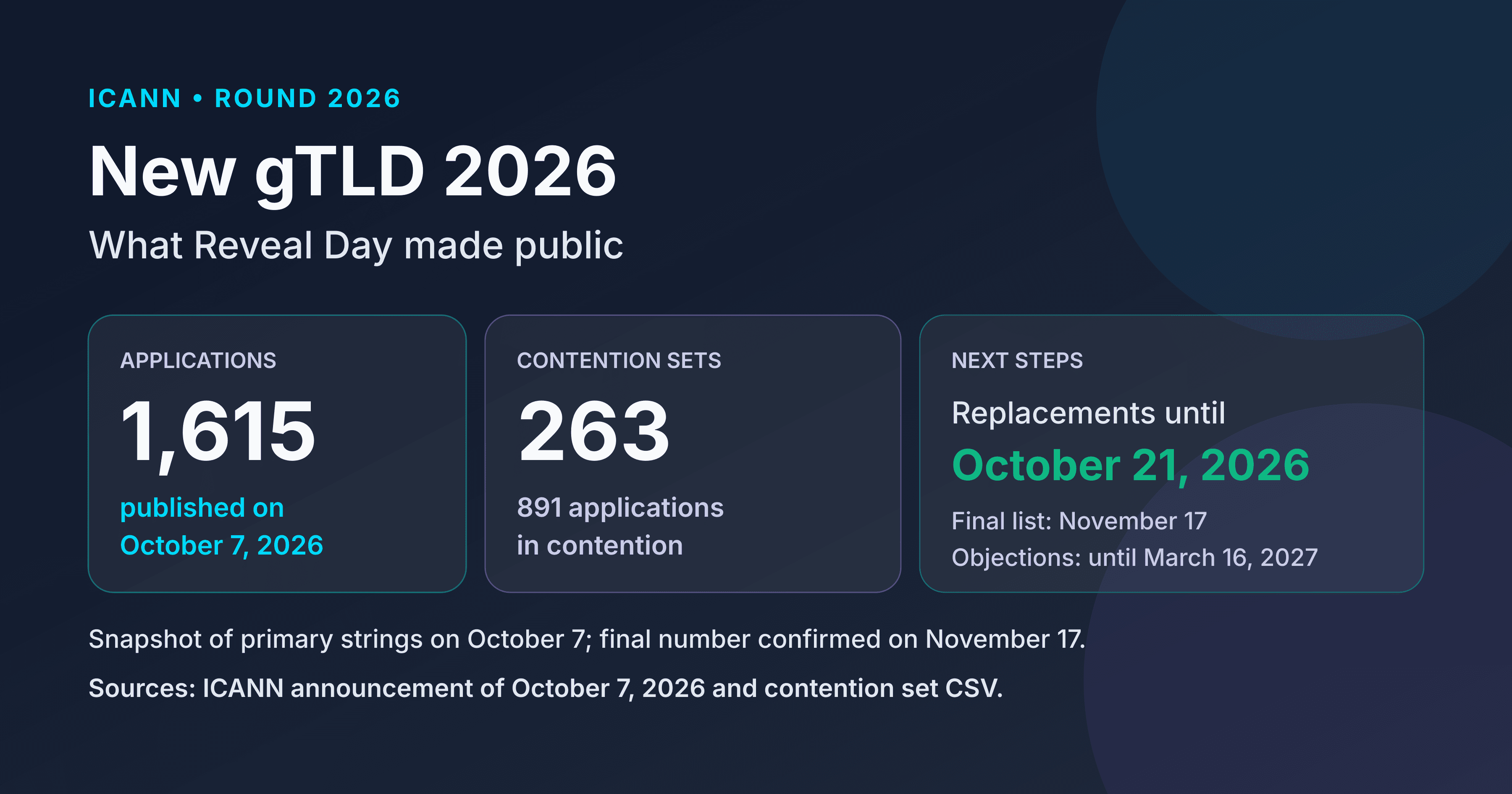
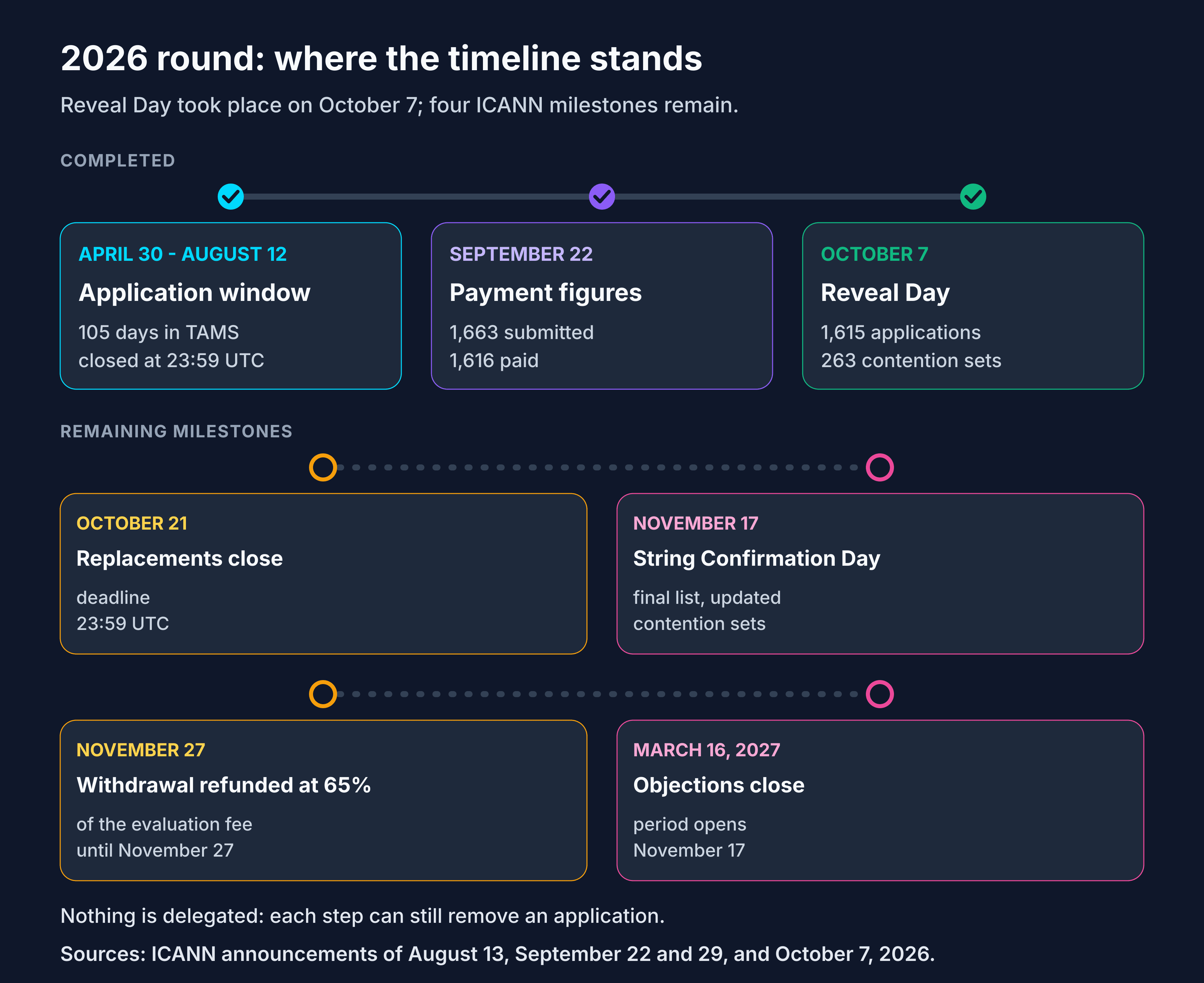
- On October 7, 2026, Reveal Day, ICANN published 1,615 primary-string applications. That is a snapshot: the final number will be confirmed on November 17.
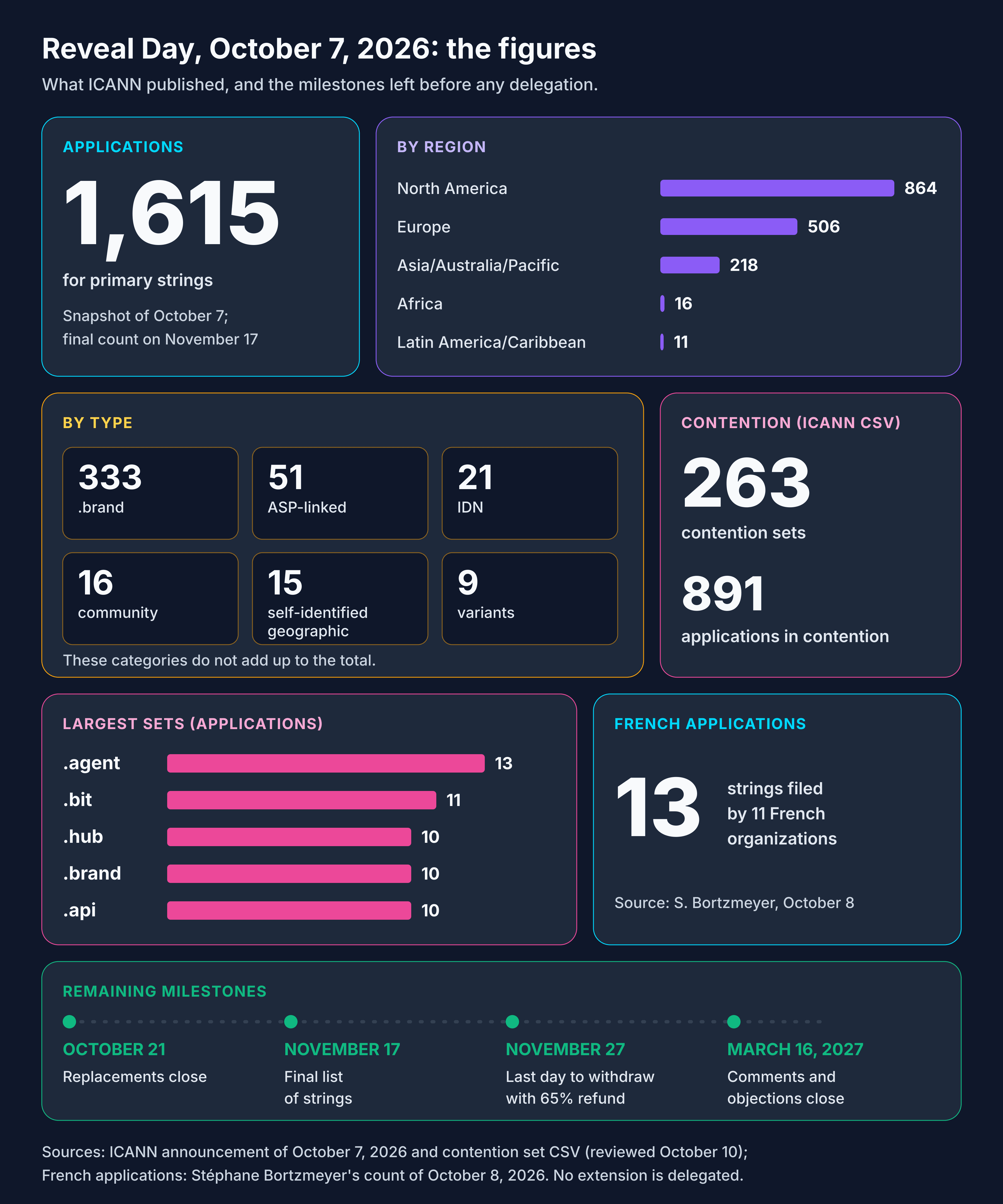
- The total includes 333 .brand, 51 applications linked to the Applicant Support Program, 21 IDNs, 16 community applications, 15 self-identified geographic names, and 9 variants. North America accounts for 864 applications, Europe for 506.
- ICANN's contention CSV lists 263 sets and 891 applications in contention. The largest, .agent, has 13 applications, including those of Charleston Road Registry (Google) and OPENAI OPCO.
- On September 22, ICANN announced 1,663 submitted applications and 1,616 paid ones. Those figures keep their date: they do not compete with the October 7 count.
- Replacements are possible until October 21 at 23:59 UTC. Comments and objections run from November 17, 2026 to March 16, 2027. No extension has been approved or delegated yet.
Updated October 10, 2026: added the results of Reveal Day on October 7 (ICANN announcement and contention set CSV) and the count published by Stéphane Bortzmeyer on October 8. The September 22 figures and the August applicant announcements keep their dates.
The window closed on August 12, the payment figures came out on September 22, and the list has been public since October 7. On that day, ICANN published the applicants, the requested strings, the contention sets, and the public portions of the applications. Neither payment nor publication proves successful completion of the administrative review or approval of an extension.
This report separates the published figures, the steps set out in the Applicant Guidebook, and the questions that remain open. The goal is not to explain how to apply: it is too late for this round. It is to know what to monitor now, whether you manage a brand, a domain portfolio, a registrar, a hosting provider, or a DNS infrastructure.
Reveal Day results, October 7
On Reveal Day (October 7), ICANN counts 1,615 primary-string applications. That is a snapshot, and the final number will be confirmed on November 17. On September 22, ICANN had announced 1,663 submitted applications and 1,616 paid ones. Counting replacement strings as well, Stéphane Bortzmeyer reached 2,783 applications on October 8 (1,614 without replacements) for 1,430 distinct strings and 480 applicants. According to him, that is where the gap with ICANN's figure comes from: ICANN counts only primary strings, while his own total also includes replacement strings, filed in case the primary string is not retained. ICANN counts 21 IDN applications, Bortzmeyer 27 IDNs: the two counts differ.
Application types and regions
According to ICANN's October 7 announcement, the 1,615 applications include 333 .brand applications, 51 applications linked to the Applicant Support Program, 21 IDNs, 16 community applications, 15 self-identified geographic name applications, and 9 variants. These categories do not partition the total: they do not add up to 1,615.
The regional split is lopsided. North America accounts for 864 applications, Europe for 506, Asia/Australia/Pacific for 218, Africa for 16, and Latin America and the Caribbean for 11. Those five values do add up to 1,615. Africa and Latin America combined weigh 27 applications, less than 2% of the total.
Contention sets: .agent at the top
The CSV file ICANN published for Reveal Day, reviewed on October 10, lists 263 contention sets covering 891 applications. These sets are preliminary: an applicant that activates a replacement string by October 21 can leave its set, and ICANN will publish an updated list on November 17.
The largest set covers .agent, with 13 applications. It includes Charleston Road Registry (Google), Meta Registry Holdings, OPENAI OPCO, Radix, XYZ.COM, and Open Agent Registry, among others. Next come .bit (11 applications), .hub, .brand, and .api (10 each), then .robot and .pop (9 each). Here, .brand means the string itself, not the category of .brand applications.
For a brand, a string in contention does not belong to anyone yet. The outcome goes through the Guidebook mechanisms described below, with the ICANN auction as a last resort. The .brand gTLD risks guide covers the brand-side scenarios, including auction and withdrawal.
Thirteen French applications
Stéphane Bortzmeyer's count lists 13 strings requested by 11 French organizations: aiagent and socialmedia (THE BEST), airliquide, atos, avocat (a court of appeal bar association, Ordre des avocats), bpce, cnp and cnpassurances (CNP Assurances), conex, ledger, mbda, michelin, and sodexo. CNP Assurances and THE BEST each filed two strings, which explains the gap between 13 applications and 11 organizations.
What these figures do not say
Nothing has been delegated. A string published on October 7 can still be replaced until October 21, withdrawn with a refund of 65% of the evaluation fee until November 27 at 23:59 UTC, targeted by an objection until March 16, 2027, and then lose a contention. A prioritization draw, planned for 2027, is then due to order the processing of applications. For legal teams: ICANN is closed from December 19, 2026 at 01:00 UTC to January 4, 2027 at 16:00 UTC.
The window closed after 105 days
The submission period ran from April 30 to August 12, 2026 at 23:59 UTC. It lasted 15 weeks, or 105 days.
Applicants went through TAMS, ICANN's application management system. At closing time, the system was supposed to block new submissions. No late filing was planned. This rule draws a clear line between a submitted application and a draft left sitting in the system.
ICANN announced on August 13 that it had received more than 1,600 primary applications. That threshold does not say how many distinct strings were requested. Several applicants can target the same string, and strings judged similar can end up in the same contention set. An application is therefore neither a unique extension nor a future delegation.
Filing clustered toward the end of the window. In its August 13 announcement, ICANN notes that most applications arrived in the final days, without publishing a day-by-day breakdown. That detail matters for reading the volume: the threshold announced right after closing was a raw count, before the September 22 payment figures.
From submission to payment: 1,616 paid applications as of September 22
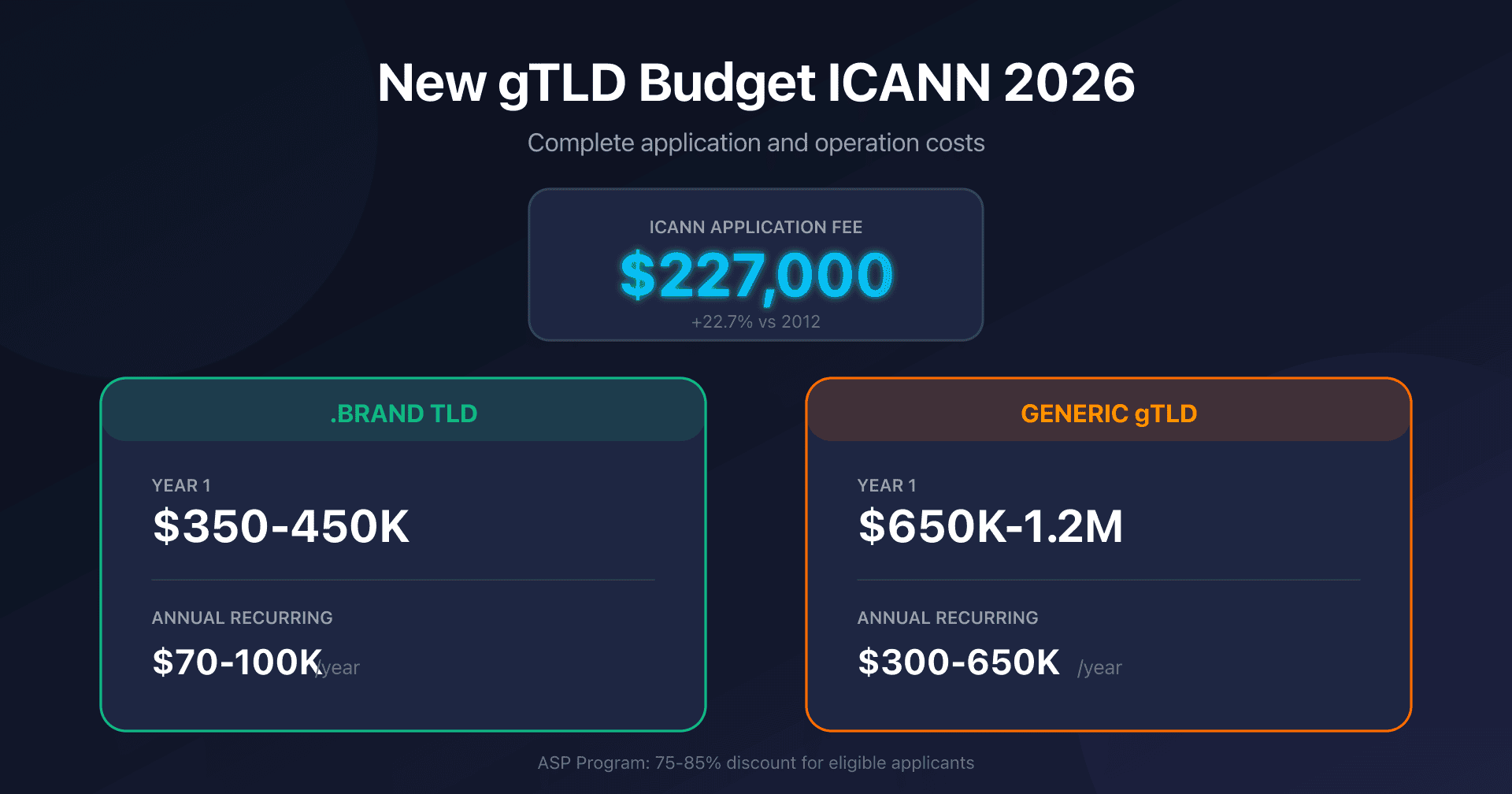
An application does not move forward if the evaluation fees are not received within the applicable deadline. The base fee is $227,000 per application, excluding conditional evaluations and certain variant cases.
According to the ICANN announcement of August 13, 2026, ICANN had to receive full payment by the later of two deadlines: August 19, 2026 at 23:59 UTC, or seven days after the invoice was sent. An invoice sent on August 14, for example, pushed the limit to August 21 at 23:59 UTC. The August 19 date was therefore not a universal cutoff.
The September 22 announcement gives the figures: 1,663 applications were submitted, and ICANN received payment for 1,616, allowing them to proceed through the process. These figures count applications without establishing the number of unique strings, approved extensions, or future delegations. The difference between them reveals neither the reason for nonpayment nor a drop-out rate to apply to the round. The Reveal Day count, 1,615 primary-string applications, is another snapshot, published fifteen days later. It does not compare line by line with the 1,616 paid applications: each number keeps its date and its source.
What does the threshold of 1,100 applications with replacements mean?
According to the ICANN announcement of August 13, more than 1,100 primary applications included at least one secondary application for a replacement string. That August 13 threshold does not automatically describe the applications published in October. These secondary files do not add to the primary volume as 1,100 future independent gTLDs. Stéphane Bortzmeyer's count gives the order of magnitude after publication: 2,783 applications with replacement strings, 1,614 without.
The mechanism was designed to reduce certain contentions. Before closing, an applicant could submit a primary string and one or more replacement strings. From October 8 to 21, applicants can decide whether to keep the primary string or activate an already filed replacement string. They cannot invent a new string at that point.
This nuance changes how the August headlines should be read. "More than 1,600 primary applications" measured the projects that entered the round. "More than 1,100 with a replacement" measured the use of a fallback option. Adding the two would produce a misleading number.
Does a replacement string avoid all contention?
No. A replacement string can itself be identical or judged similar to another string. It gives the applicant a choice; it does not automatically reserve a path with no competitor. Even once selected, it can end up in contention later, for example after a singular/plural notification or a string confusion objection.
The timeline makes the decision delicate. On October 7, Reveal Day published the public parts of the applications and the list of contention sets. The 14-day replacement period opened on October 8 at 00:01 UTC and ends on October 21 at 23:59 UTC. Applicants can switch only if their replacement string is eligible: it must not be identical to another primary string or to another replacement string. They decide with more information, but on a short deadline. The final list of strings will be published on String Confirmation Day, November 17.
For observers, Reveal Day therefore delivered a first map, not the final land registry. Brand monitoring that stops at the October 7 list risks keeping alerts on strings that are later replaced. Conversely, waiting for String Confirmation Day can cost time when preparing an objection or a comment.
Administrative review comes before public transparency
ICANN first checks that submitted and paid applications meet the program's administrative requirements. The September 22 announcement confirms payment for 1,616 applications; it does not say that all of them have already passed this review.
The review does not prejudge the outcome of the substantive evaluations. It mainly verifies that the application can enter processing. Examinations of the string, the applicant, the financial and operational capabilities, and the safeguard measures come next, depending on the applicable path.
On September 29, 2026, ICANN had set Reveal Day for October 7, 2026 at 18:00 UTC, eight weeks (56 days) after closing. Publication did take place on October 7. The same announcement dated the replacement period, from October 8 to 21, and String Confirmation Day, on November 17.
The September 29 timeline placed Reveal Day eight weeks after closing, not nine months. That duration sometimes circulates because it is confused with the whole evaluation process, which is much longer. For the initial publication of applications, the correct unit was the week.
What Reveal Day made public
The September 29 announcement listed the content of Reveal Day: the applicant entities, all primary strings and any applicable variant or replacement strings, the list of contention sets, and the public portions of each application. ICANN published that data on October 7; the contention set CSV is part of it.
The website designated for this publication, Application Publication and Statistics (APS), is separate from TAMS: it uses public data from TAMS, while TAMS remains the application management system.
Information that is protected or designated confidential under the program's rules is not posted online in full. Reveal Day did not open all internal files. It is still enough to start the competitive and legal analysis.
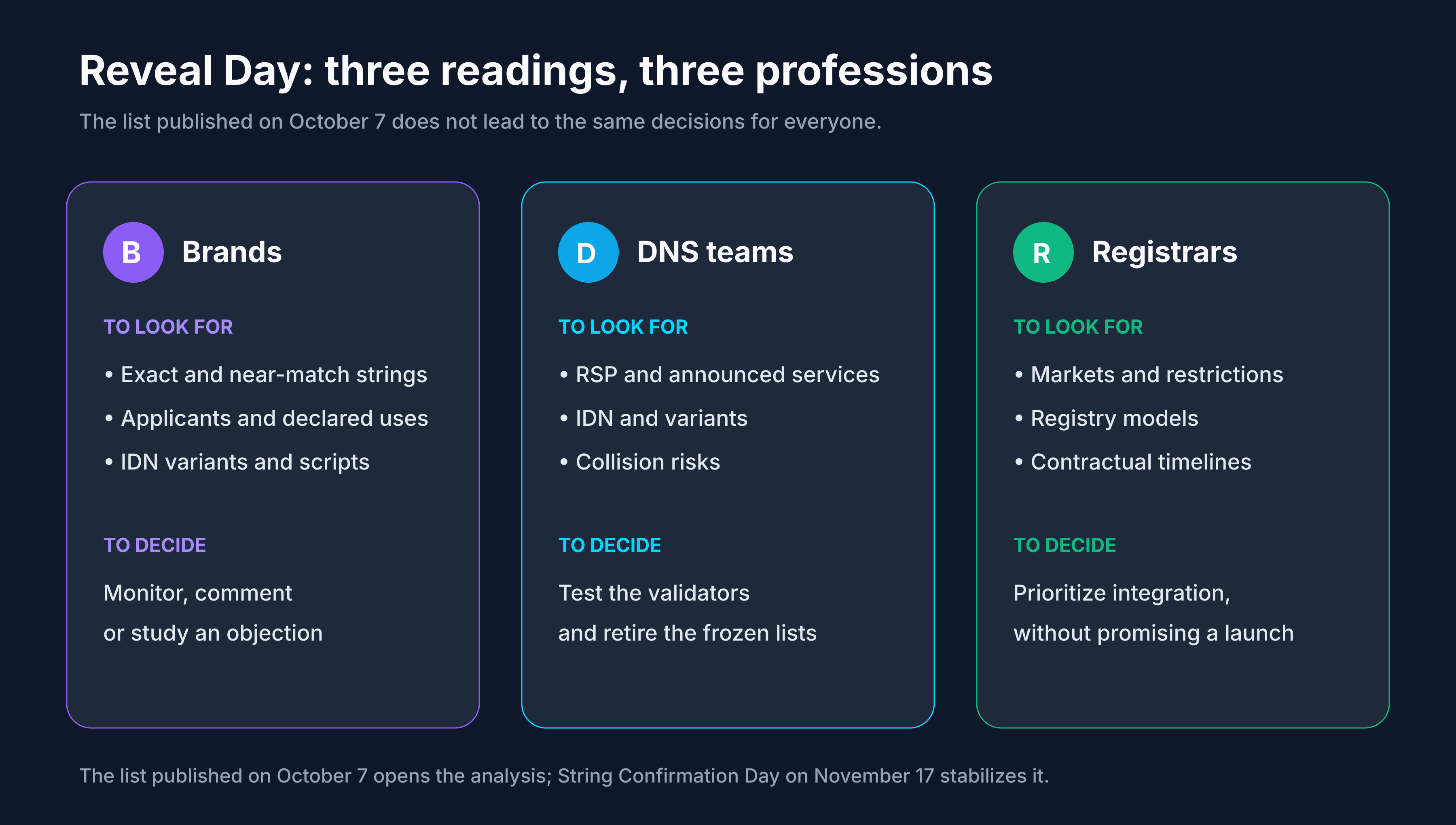
Three readings start with this publication. The first looks for exact strings matching a brand. The second widens to visual, phonetic, and semantic similarities. The third looks at the applicant, the declared business model, and any IDN variants. A simple Ctrl+F on a company name misses a good part of the risk.
What steps follow Reveal Day?
Reveal Day opened the public sequence: replacement period, string confirmation, comments and objections, evaluations, and contention resolution. The exact order for a given application depends on its type and the issues encountered.
The public comment period opens on November 17. The objection procedures cover distinct grounds, including string confusion, legal rights, limited public interest, and community opposition. These paths have their own criteria, costs, and deadlines. A public comment is not a disguised formal objection.
Governments also step in through the Governmental Advisory Committee, notably through advice addressed to the Board. In parallel, strings go through evaluations such as similarity, DNS stability, reserved names, name collisions, and, depending on the case, geographic review.
String Confirmation Day comes after the replacement period, on November 17, 2026. ICANN will publish the final list of applied-for strings and an updated list of contention sets that day. The date opens the comment and objection period, which runs until March 16, 2027, as well as the last 10 days for withdrawing with a refund of 65% of the evaluation fee, on request by November 27 at 23:59 UTC. A prioritization draw, planned for 2027, is then due to order the processing of the relevant applications. The 1,615 applications published on October 7 will not necessarily all reach every subsequent stage.
How do contention sets work?
A contention set groups applications that cannot all succeed as they stand. The obvious case is an exact string requested by several applicants; confusing similarity can also link different strings. On Reveal Day, ICANN published 263 of them.
Applicants can exit a contention through the authorized mechanisms, including the community priority evaluation for certain community applications and the ICANN auction as a last resort. The 2026 Guidebook prohibits private resolutions that would amount to paying a competitor to withdraw its application. That is a notable difference from the practices observed after 2012.
A brand must therefore not confuse "requested string" with "won string". Between the two lie the objections, the evaluation, a possible contention, the registry agreement, the pre-delegation tests, and insertion into the root. A long road.
What the 2012 round lets us compare, and nothing more
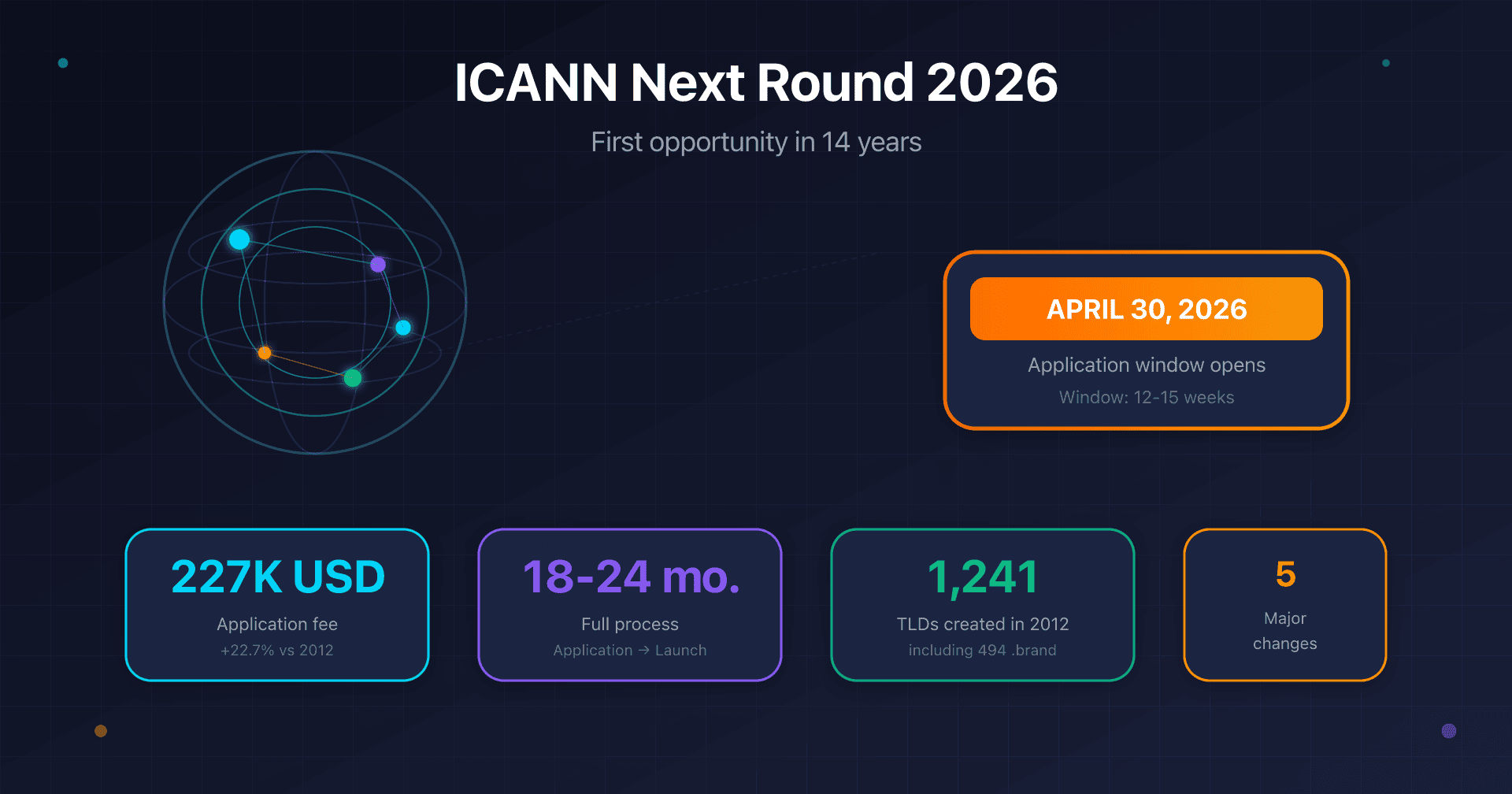
The 2012 round received 1,930 applications and led to more than 1,200 delegations. As of June 30, 2026, ICANN statistics counted 1,241 delegated gTLDs from that round.
These numbers give an order of magnitude, not a conversion rate applicable to 2026. The previous round produced about 1,400 unique strings and 234 contention sets. It also saw 653 withdrawn applications according to the June 2026 count. An application could fail, be abandoned, or remain stuck in a procedure for years.
The new round has changed several pieces of the mechanism. Replacement strings provide a prepared exit from certain contentions. RSPs are evaluated in a separate program. Applicant support opened well before the main window. The rules on private auctions have also been revised.
The 1,615 applications published on Reveal Day can be compared with the 1,930 received in 2012. Strings and contentions call for more caution. Stéphane Bortzmeyer's 1,430 distinct strings include replacement strings, and the 263 sets of October 7 are preliminary, before replacements. Setting them against the roughly 1,400 strings and 234 sets of 2012 would compare counts built on different bases. None of these figures can be used to infer the number of future delegations.
The side programs have already changed the landscape
The Applicant Support Program and the RSP Evaluation Program run alongside the main filing. They address two different obstacles: access to the program and the technical capacity to operate a registry.
Applicant Support Program
The ASP targeted entities that would not have had the financial means or resources to apply on their own. Its window opened on November 19, 2024. It closed to new applications on November 19, 2025, with a deadline of December 19 for certain applications already in progress.
Qualified applicants can receive a 75% to 85% reduction on evaluation fees, along with non-financial support. The percentage depends on the final number of beneficiaries. This qualification does not amount to approval of a gTLD: the supported applicant must still file a primary application and go through the same applicable evaluations. On Reveal Day, ICANN counted 51 applications linked to the ASP.
The program also provides an auction credit of up to 35% of the winning bid, capped at $1.75 million per eligible application. This only comes into play if the application reaches an ICANN auction. It does not resolve a valid objection or a technical weakness.
RSP Evaluation Program
The RSP program separates the evaluation of the technical provider from that of the requested string. Each gTLD applicant will have to designate one or more evaluated RSPs before its application is evaluated.
ICANN published a first list of evaluated providers on January 30, 2026, then expanded it. A second and final RSP window ran from April 30 to August 12. The list will continue to evolve as providers complete their tests.
This separation is directly relevant to registrars and hosting providers. It concentrates the operation of functions such as authoritative DNS, EPP, RDAP, DNSSEC, and data escrow in operators vetted upstream. It does not make all RSPs interchangeable: IDN coverage, additional services, capacity, commercial terms, and architecture still need to be compared.
What brands should monitor right now
A brand that did not apply can still act on monitoring and defending its rights. The closing of the window does not close the public procedures.
With the list now public, the domain team can check its inventory of trademarks, transliterations, product names, abbreviations, and regulated terms against the published strings. A pass through the RDAP Lookup tool lets you check the current state of records and their holders. Legal counsel should be brought in early enough to decide which signals would justify an objection: the period opens on November 17 and closes on March 16, 2027. Waiting until the last week to look up rights holders wastes days for nothing.
Keep a dated copy of the October 7 list and classify each match. An exact string does not carry the same level of risk as a nearby generic term. Also document the applicants, the declared uses, and the variants. The file should remain readable by someone who has not followed the round since 2024.
Security teams look beyond trademark law. A similar new string can feed phishing or confusion, but its operation is not immediate: it still has to win, sign a contract, and be delegated. The right reflex is to prepare detection without announcing an active threat before it exists.
What DNS professionals, registrars, and hosting providers should prepare
Operators must first track the final strings and the selected RSPs. Commercial volumes and launch dates remain unknown at the application stage.
A registrar can map the extensions that match its markets, then monitor the contracts, the Sunrise periods, and the eligibility rules. Nothing yet justifies promising a catalog. Since Reveal Day, each registry follows its own path toward the opening of registrations.
For DNS and email teams, the subject is more discreet. The new TLDs will have to enter the public suffix lists, the validation rules, the anti-abuse filters, and the interfaces that still hard-code a frozen list of extensions. A regular expression limited to a few historical TLDs will break. It was already breaking before this round, to be honest.
Hosting providers will also need to distinguish syntactic acceptance from trust. Accepting an address under a new TLD does not mean lifting reputation checks. Conversely, blocking all unknown extensions creates false positives from the very first delegations.
Action plan after Reveal Day
The useful work comes down to dated monitoring, named responsibilities, and reaction criteria written before the objection period opens.
- Compare the list published on October 7 with your brands, language variants, and sensitive strings.
- Designate one person for the remaining ICANN milestones: October 21, November 17, November 27, and March 16, 2027.
- Sort each result in a grid that separates exact match, similarity, and generic term.
- Agree with legal on the thresholds for comment, objection, or simple monitoring.
- Check that your applications accept new TLDs without a hard-coded list.
- Redo the analysis on String Confirmation Day, November 17, to remove the replaced strings.
- Then follow the evaluations, contentions, contracts, and delegations application by application.
The trap is to treat Reveal Day as a verdict. It was a massive, provisional publication that replacements may change. The monitoring must keep the history: primary string, any replacement, status, applicant, and next deadline.
What remains open after Reveal Day
Applications, strings, and contention sets have been public since October 7, and the timeline is set through March 16, 2027. What remains open is the final number of applications, which ICANN will confirm on November 17, and the makeup of the contentions after replacements.
The published counts still differ on two points: 1,615 applications according to ICANN versus 1,614 without replacements according to Stéphane Bortzmeyer, and 21 IDNs versus 27. The November 17 list will be the next point of comparison. The voluntary lists that applicants and the media circulated in August now serve only as history: the official publication replaces them.
Replacements made from October 8 to 21 can still change the list of strings and contentions before November 17.
Finally, no overall delegation date can be inferred. Some applications will move faster; others will hit an objection, a contention, or an additional evaluation. The round is now observable. It is far from over.
History: public announcements as of August 28, 2026
Before the official publication, several applicants had disclosed volumes or strings. This survey, dated August 28, is kept as history and is not exhaustive: the figures come from applicants or the media, not from ICANN. The October 7 list now makes it possible to check them.
On August 13, Link Freedom Group, the group behind Nova Registry and .link, announced "more than 300" submitted strings. Its website details 316 primary and replacement strings combined; specialist media report that number as the total number of applications. On August 17, Journey to the West announced "more than 100" applications. Its website displays 323 primary and replacement strings; that number does not represent filed applications. Domain Name Wire also notes at least six names on the list that are already delegated, a website still under construction, and an identity that remains unclear. The list therefore cannot be used to count applications.
Among the other dated disclosures, Oinkadot announced 25 applications on August 15, and Telegram revealed .gram on August 18. On August 20, WebHosting.Today attributed 40 applications to Namecheap through Starlight Registry; that figure comes from the media, with no Namecheap press release. On August 27, Radix reported 46 applications and published a portfolio presentation.
Domain Incite also reported in mid-August eight applications for Endpoint Domains, four for TLD1 LLC, and .factory for USA Made in America. These disclosures were still changing: on August 26, Domain Name Wire reported that Unstoppable had ultimately not applied for .crypto, .wallet, and other strings, while partners had withdrawn .agent, among others.
Frequently asked questions
FAQ
How many New gTLD 2026 applications were published?
On Reveal Day, October 7, 2026, ICANN counted 1,615 primary-string applications; the final number will be confirmed on November 17. On September 22, ICANN had announced 1,663 submitted applications and 1,616 paid ones. These figures represent neither unique strings nor approved extensions.
When did the 2026 round's Reveal Day take place?
On October 7, 2026, the date set by the ICANN announcement of September 29. The replacement period runs from October 8 to 21, and String Confirmation Day falls on November 17.
Which string has the most applications?
.agent, with 13 applications in the same contention set, according to the CSV ICANN published for Reveal Day. Next come .bit (11), then .hub, .brand, and .api (10 each). In total, 263 sets cover 891 applications.
How many French applications were filed?
According to Stéphane Bortzmeyer's count of October 8, 11 French organizations filed 13 strings, including airliquide, bpce, michelin, and sodexo. CNP Assurances and THE BEST filed two each.
Is a replacement string a second, independent application?
No. It is tied to a primary application and provides an option prepared before closing. The applicant can choose during the replacement period, from October 8 at 00:01 UTC to October 21 at 23:59 UTC, if the replacement string is eligible.
Did Reveal Day provide the final list of future extensions?
No. Reveal Day published the requested strings, the contention sets, and the public portions of applications. The final list of strings will be published on November 17; withdrawals, objections, evaluations, and contentions will then decide which extensions succeed.
Can a brand that did not apply still take action?
Yes. It can monitor the strings published since October 7, comment on an application, and, if the criteria are met, use an objection procedure between November 17, 2026 and March 16, 2027. The choice depends on the right invoked and the case.
How many new gTLDs will ultimately be delegated?
Nobody can calculate that at this stage. No extension from the 2026 round has been delegated. An application can be withdrawn, rejected, lose a contention, or fail to reach the contract and delegation.
Is the 2026 program the same as the 2012 round?
No. The framework reuses part of the 2012 path but adds, notably, replacement strings, the separate RSP evaluation, and new contention rules.
Glossary
- gTLD: a generic top-level domain, placed to the right of the final dot in a domain name.
- String: the label requested as a future TLD, without the leading dot in ICANN documents.
- IDN: an internationalized domain name, written with non-ASCII characters (accented letters, other scripts) and encoded in ASCII in the DNS.
- Contention: a situation in which several applications cannot all succeed because of identical or similar strings.
- Contention set: a group, published by ICANN, of applications linked by identical or similar strings.
- Reveal Day: publication on APS, on October 7, 2026, of the requested strings, contention sets, and public portions of applications.
- String Confirmation Day: November 17, 2026, the date on which ICANN publishes the final list of strings after the replacement choices.
- ASP: the Applicant Support Program, an ICANN program that gives qualified applicants a reduced evaluation fee and non-financial support.
- RSP: a provider that supplies a registry's technical functions, including DNS, EPP, and RDAP.
- Delegation: the addition of the TLD to the DNS root zone after contract and checks.
📚 Related ICANN and .brand guides
- ICANN 2026 Next Round: introduction - Timeline, process, and opportunities in the new gTLD round.
- 2026 gTLD budget: complete costs - All application and operating costs, from $350K to $450K for a .brand.
- .brand gTLD risks: 6 scenarios and contingency plans - Anticipate risks before applying: auction, withdrawal, migration, and M&A.
Sources
- ICANN, 2026 round applications revealed on Reveal Day, October 7, 2026
- ICANN, Reveal Day contention sets (CSV)
- Stéphane Bortzmeyer, count of 2026 gTLD applications (in French), October 8, 2026
- ICANN, Reveal Day date and 2026 round milestones, September 29, 2026
- ICANN, submitted and paid application figures, September 22, 2026
- ICANN, 2026 round closes with provisional figures
- Applicant Guidebook 2026, Module 3 on submission and payments
- ICANN, Applicant Support Program
- ICANN, Registry Service Provider Evaluation Program
- ICANN, 2012 round statistics
- Link Freedom Group, public announcement
- Link Freedom Group, public portfolio
- Domain Name Wire, Journey to the West
- Journey to the West, announced strings
- Domain Name Wire, Oinkadot
- Domain Name Wire, Telegram and .gram
- WebHosting.Today, portfolio attributed to Namecheap
- Domain Name Wire, Radix
- Radix, announced portfolio
- Domain Incite, public announcements for the 2026 round
- Domain Name Wire, withdrawals linked to Unstoppable Domains