RFC 10023: registered domains can signal that they are for sale
By CaptainDNS
Published on September 17, 2026
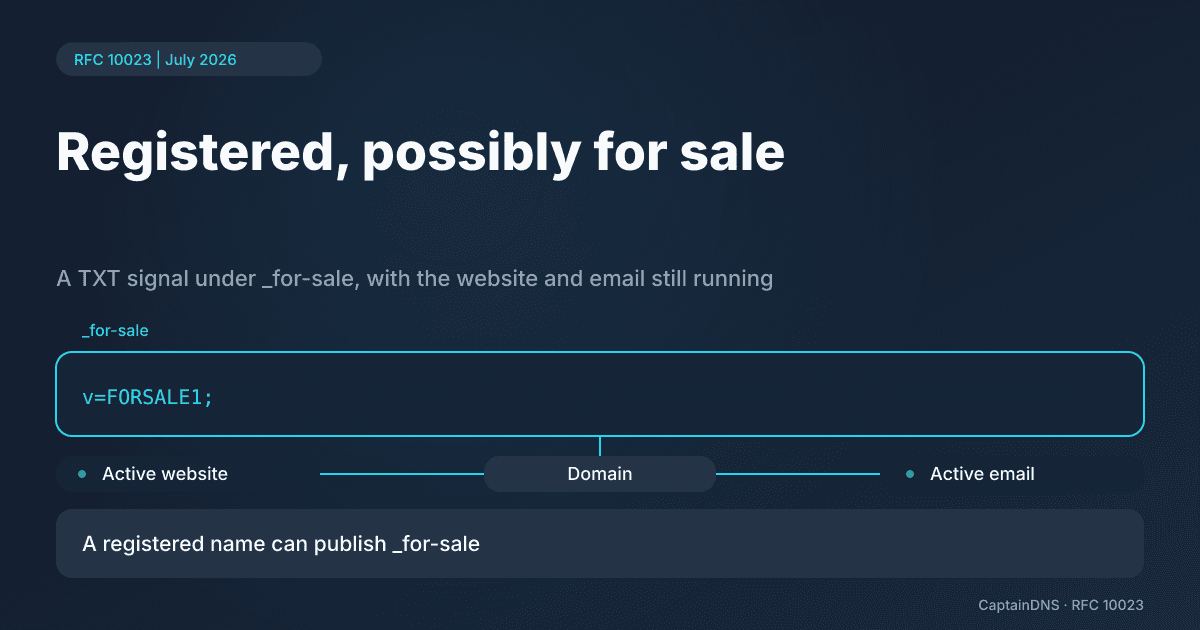
The domain you want is already taken. Its website loads and its email addresses work, but the registrant may still be open to selling. Published on July 30, 2026, RFC 10023 describes a DNS signal for expressing that intent. To check it, query the TXT record at _for-sale. A missing answer does not mean the registrant is unwilling to discuss a sale.
- A registered domain can publish a for-sale signal while keeping its website and email active.
- RFC 10023, published on July 30, 2026 with Informational status, describes the TXT record to query at
_for-sale. - Check for the
v=FORSALE1;prefix. An absent signal does not mean the registrant refuses to sell.
Signal a sale while keeping the website and email running
The _for-sale node expresses an intent to sell separately from the website and email records. Registrants can signal their interest in a transfer without replacing their website with a parking page or interrupting email service. For a potential buyer, this provides information that a visit to the website may not reveal.
RFC 10023, by Marco Davids at SIDN Labs, describes an operational convention that uses the existing DNS. Its Informational status does not make it a mandatory IETF standard, and no protocol changes are needed. The term "sale" also covers leasing or transferring the right to use the domain.
SIDN ran a pilot for .nl before publication; the convention is intended for the global DNS, and the _for-sale entry for TXT is listed in the IANA registry as of September 17, 2026. That listing reserves a name and a use. It does not measure adoption by registrants or domain search services.
What this article does not cover
Expiration and EPP statuses are part of the domain name lifecycle, separate from a for-sale signal on an active domain.
The RDAP vs WHOIS guide covers registration data. That data describes a domain's registration status; _for-sale expresses an intent to sell. Learning that a domain is registered does not tell you whether a transfer is possible. This article covers reading the DNS signal, before any contact or negotiation.
Check the _for-sale TXT record with dig or DNS Lookup
Query the TXT record type for _for-sale followed by the domain you want to check. With dig, the command is:
dig TXT _for-sale.example.com
Replace example.com with the domain you are interested in. This is an example query; it does not imply that this domain currently publishes a signal. To check without a terminal, open CaptainDNS DNS Lookup, select TXT, and enter _for-sale.example.com, replacing the domain as needed.
In the answer, look for the exact prefix v=FORSALE1; at the start of the TXT record. It is case-sensitive and contains no spaces. A TXT record without this prefix must not be treated as a for-sale signal. If none of the node's TXT records has this valid prefix, the node is invalid under this convention, even if its name is _for-sale.
Each record contains a single TXT string of up to 255 bytes, with at most one tag=value pair after the prefix. Multiple TXT records can coexist at the same name. Do not combine all four tags into a single TXT record.
The tags are fcod for an opaque code agreed between parties, ftxt for human-readable text, furi for a URI, and fval for an indicative price.
Here is one fictional TXT record, not an observed DNS response:
"v=FORSALE1;fval=EUR500"
It indicates an asking price of 500 euros, for guidance only. Content after the prefix is optional: v=FORSALE1; on its own should still be read as a for-sale signal unless local policy says otherwise. In that case, it provides neither a price nor contact details.
A valid answer signals intent; an answer without a valid prefix does not. Without a usable answer, you have not established any intent through this mechanism. A timeout or DNS error does not even prove that there is no signal: the lookup failed. None of these results establishes that a seller is legitimate.
Read the signal and verify the seller before proceeding
The TXT record proves neither that the domain is available for registration nor that the person you are talking to is authorized to transfer it. It may also contain outdated information or have been published by mistake. Keep that limitation in mind when moving from a DNS lookup to a business discussion.
Do not automatically follow a furi destination. A link can lead to a phishing page or malicious content. Review the full address before opening it; a service displaying this field should show the destination and ask for confirmation before opening it.
The fval amount is indicative. Confirm the price and terms with someone whose identity and rights to the domain you have verified. Publishing the TXT record does not oblige the registrant to sell.
Operators can choose whether to adopt this convention and integrate it into their services. The format rules explain how to read the signal where it is supported; they do not require every registrar or tool to process it. Start by inspecting the domain's TXT record.
Check the for-sale signal in DNS
Select TXT and use _for-sale.example.com, replacing the domain with the one you want to check.
FAQ
Can a registered domain be for sale?
Yes. Its registrant can publish the signal while keeping the website and email active. An existing registration does not rule out a transfer.
Does a missing _for-sale TXT record mean the domain is not for sale?
No. Publishing the signal is voluntary. Without a valid answer, this mechanism establishes neither an intent to sell nor a refusal by the registrant.
What does a TXT record containing only v=FORSALE1; mean?
It should still be read as a for-sale signal unless local policy says otherwise. Additional information is optional; this TXT record provides neither a price nor contact details.
Does the price or link in the TXT record commit the seller to a sale?
The price is indicative, and the TXT record does not guarantee a transaction. The link proves nothing about the seller's identity. Review the destination of furi before opening it.
Sources: RFC 10023 details, status, and publication and RFC 10023 text, format, and security.