MTA-STS vs DANE: which protocol to choose for securing email transport?
By CaptainDNS
Published on March 10, 2026
Updated on August 25, 2026
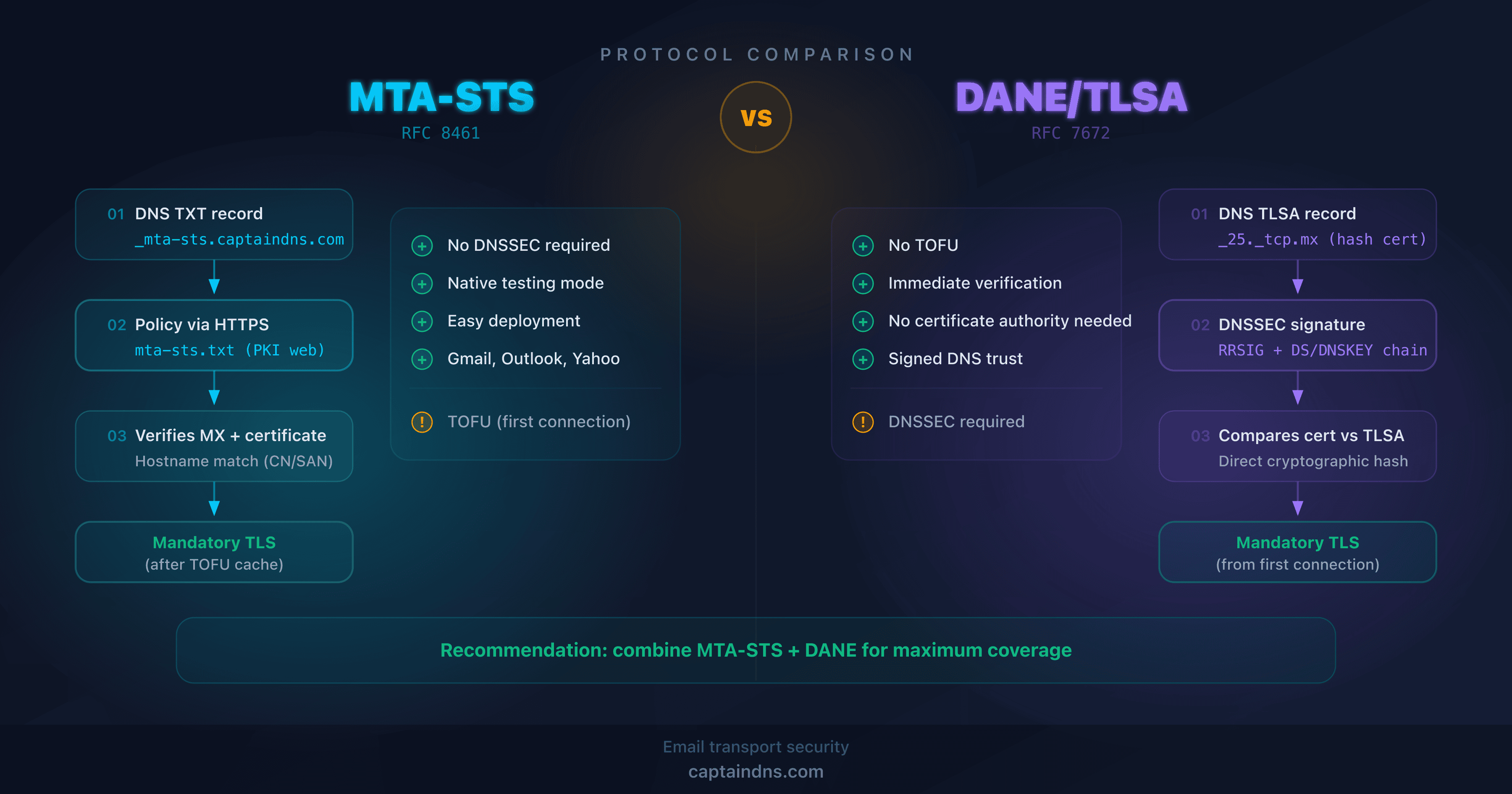
- MTA-STS (RFC 8461) publishes a mandatory encryption policy via HTTPS. It works without DNSSEC, but the first connection remains vulnerable (TOFU)
- DANE/TLSA (RFC 7672) anchors the TLS certificate in DNS signed by DNSSEC. No TOFU, but DNSSEC is mandatory across the entire chain
- The two protocols are complementary: MTA-STS covers domains without DNSSEC, DANE eliminates TOFU for those that have it
- Host your MTA-STS policy with CaptainDNS (first tool free, then €3/month excl. VAT): two DNS records are all you need
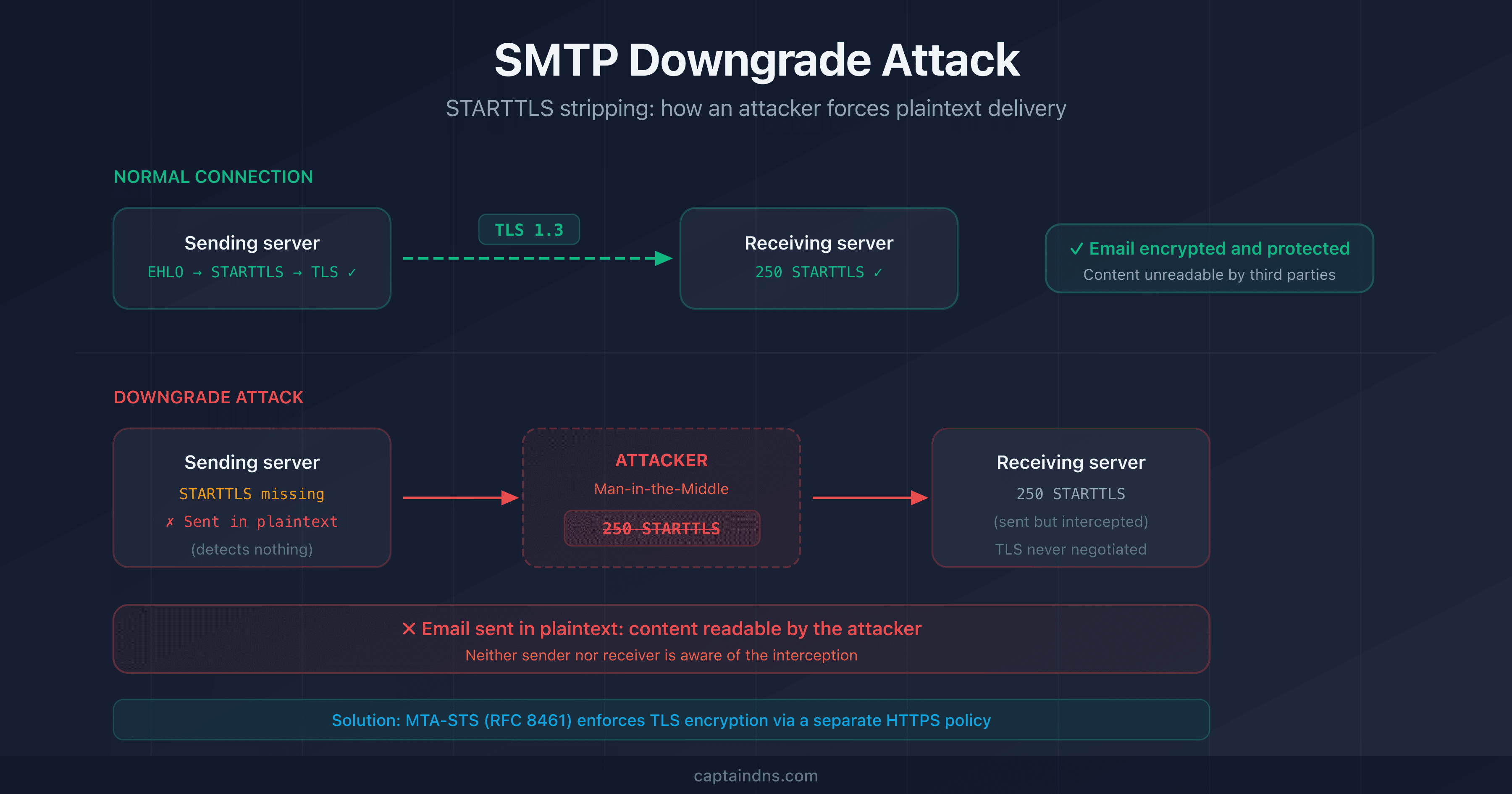
Opportunistic SMTP encryption (STARTTLS) protects the majority of emails in transit. But "opportunistic" means a network attacker can strip it away without anyone noticing. SMTP downgrade attacks exploit this weakness to intercept messages in plaintext.
Two protocols address this problem: MTA-STS (RFC 8461) and DANE/TLSA (RFC 7672). Both enforce mandatory TLS encryption between email servers. But their trust mechanisms, prerequisites, and adoption differ.
This article compares MTA-STS and DANE criterion by criterion. It identifies the use cases for each and guides you toward the best strategy for your infrastructure. If you manage email domains, whether with a cloud provider or your own MX servers, this comparison is for you.
How do MTA-STS and DANE work?
Both protocols share the same goal: prevent a sending server from delivering an email in plaintext when the receiving server supports TLS. But they use different trust channels.
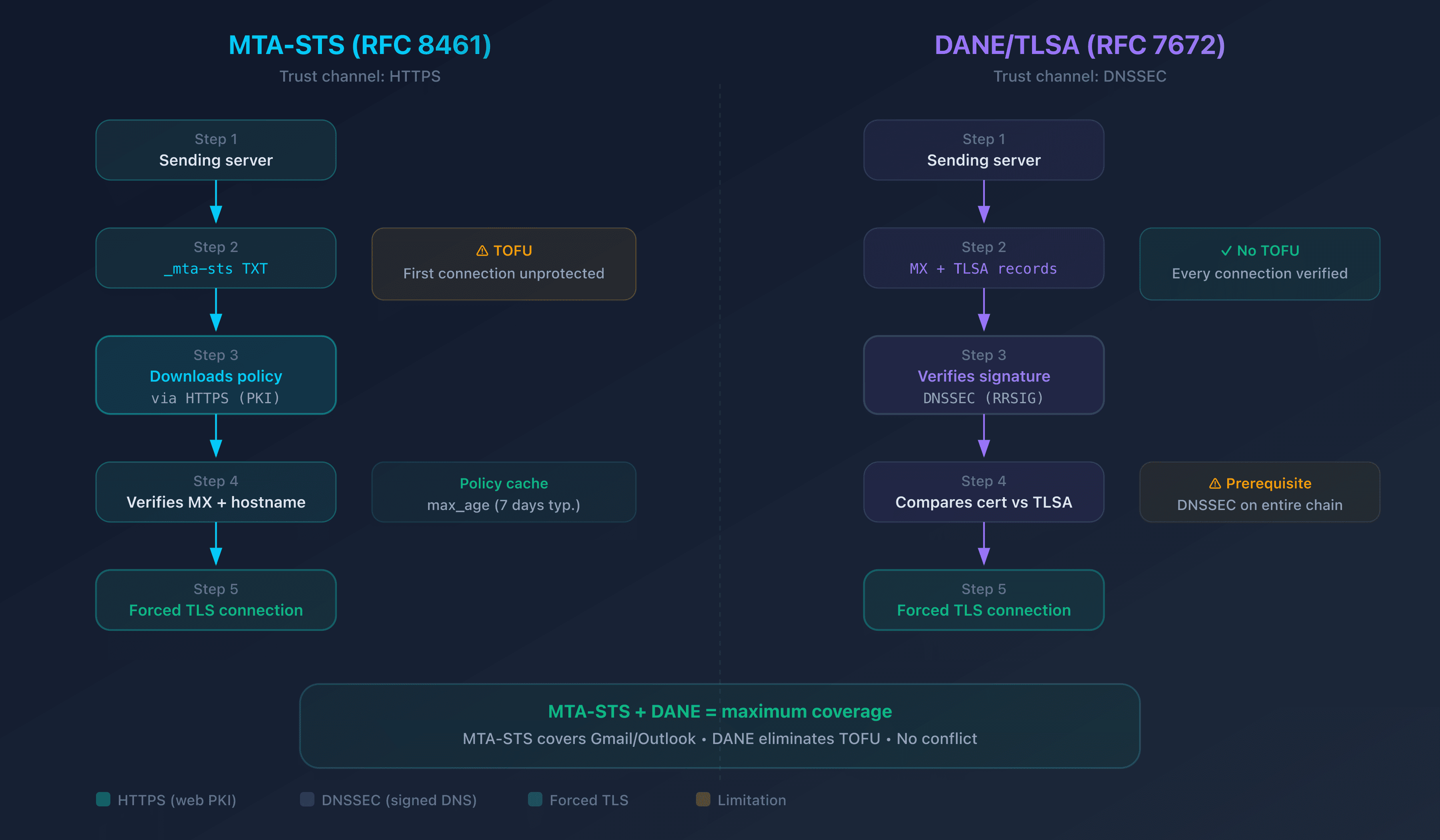
MTA-STS: a policy published via HTTPS
MTA-STS relies on two elements:
- A DNS TXT record
_mta-sts.captaindns.comthat signals the policy's existence and contains a version identifier - A text file hosted over HTTPS at
https://mta-sts.captaindns.com/.well-known/mta-sts.txtthat describes the policy: authorized MX servers, mode (testing or enforce), cache duration (max_age)
When a sending server (like Gmail or Outlook) wants to send an email to your domain:
- It queries DNS for
_mta-sts.captaindns.com - It downloads the policy via HTTPS (channel authenticated by the web certificate)
- It verifies that the MX server matches the policy
- In enforce mode, it refuses to send in plaintext or to an unlisted MX
The HTTPS channel is key: even if an attacker manipulates SMTP traffic, they cannot forge the domain's HTTPS certificate. The policy remains trustworthy.
Limitation: TOFU (Trust On First Use). The first time a sending server contacts your domain, it has no cached policy. If an attacker blocks this first HTTPS request, the sending server won't know that MTA-STS is enabled. Subsequent connections are protected thanks to the cache (valid until max_age).
DANE/TLSA: the certificate anchored in signed DNS
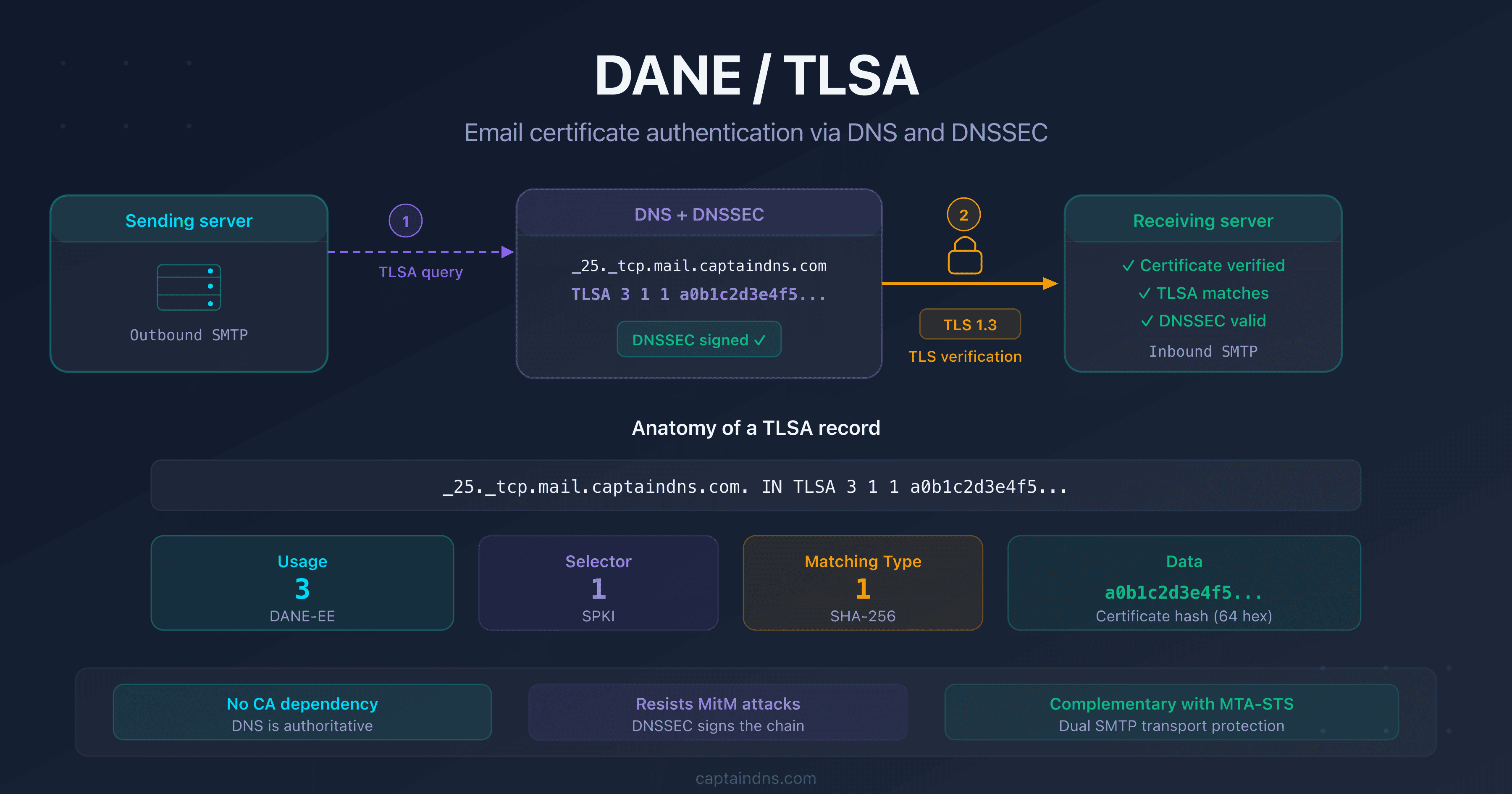
DANE works differently. It publishes the fingerprint (hash) of the MX server's TLS certificate directly in a TLSA record in DNS:
_25._tcp.mx.captaindns.com. IN TLSA 3 1 1 a0b1c2d3e4f5...
The sending server:
- Queries DNS for the MX records of
captaindns.com - Retrieves the TLSA record associated with the MX server
- Verifies the DNSSEC signature of the response (mandatory)
- Compares the TLS certificate presented by the MX server with the TLSA hash
- If everything matches, the connection is established. Otherwise, the email is not sent
Advantage: no TOFU. Each connection is verified individually via signed DNS. An attacker cannot forge the TLSA record (protected by DNSSEC) or present a fake certificate (the hash wouldn't match).
Limitation: DNSSEC is mandatory. The entire DNS chain, from the root to your zone, must be signed. If your registrar or DNS host doesn't support DNSSEC, DANE is unusable.
Detailed technical comparison
| Criterion | MTA-STS (RFC 8461) | DANE/TLSA (RFC 7672) |
|---|---|---|
| Trust channel | HTTPS (web PKI) | DNSSEC |
| First connection protection | No (TOFU) | Yes |
| DNSSEC dependency | No | Mandatory |
| Certificate validation | Hostname match (CN/SAN) | Certificate hash (TLSA) |
| Native testing mode | Yes (mode: testing) | No |
| Failure reports | Via TLS-RPT (RFC 8460) | Via TLS-RPT (RFC 8460) |
| Deployment complexity | Low (2 DNS records + HTTPS file) | High (DNSSEC + TLSA records + rotation) |
| Revocation | Modify the policy (delay = max_age) | Modify the TLSA record (delay = TTL) |
| Sender adoption | Gmail, Outlook, Yahoo, Proton Mail | Postfix, Exim, some EU operators |
| Web standard required | Yes (valid HTTPS certificate) | No |
What this table shows
MTA-STS wins on accessibility: no DNSSEC required, built-in testing mode, wide adoption by major providers. It's the protocol that the majority of domains can deploy immediately.
DANE wins on security: no TOFU, direct cryptographic verification, no dependency on a web certificate authority. But it requires DNSSEC, which remains a major barrier.
Which protocol to choose based on your situation?
There's no universal answer. The choice depends on your DNS infrastructure and constraints.
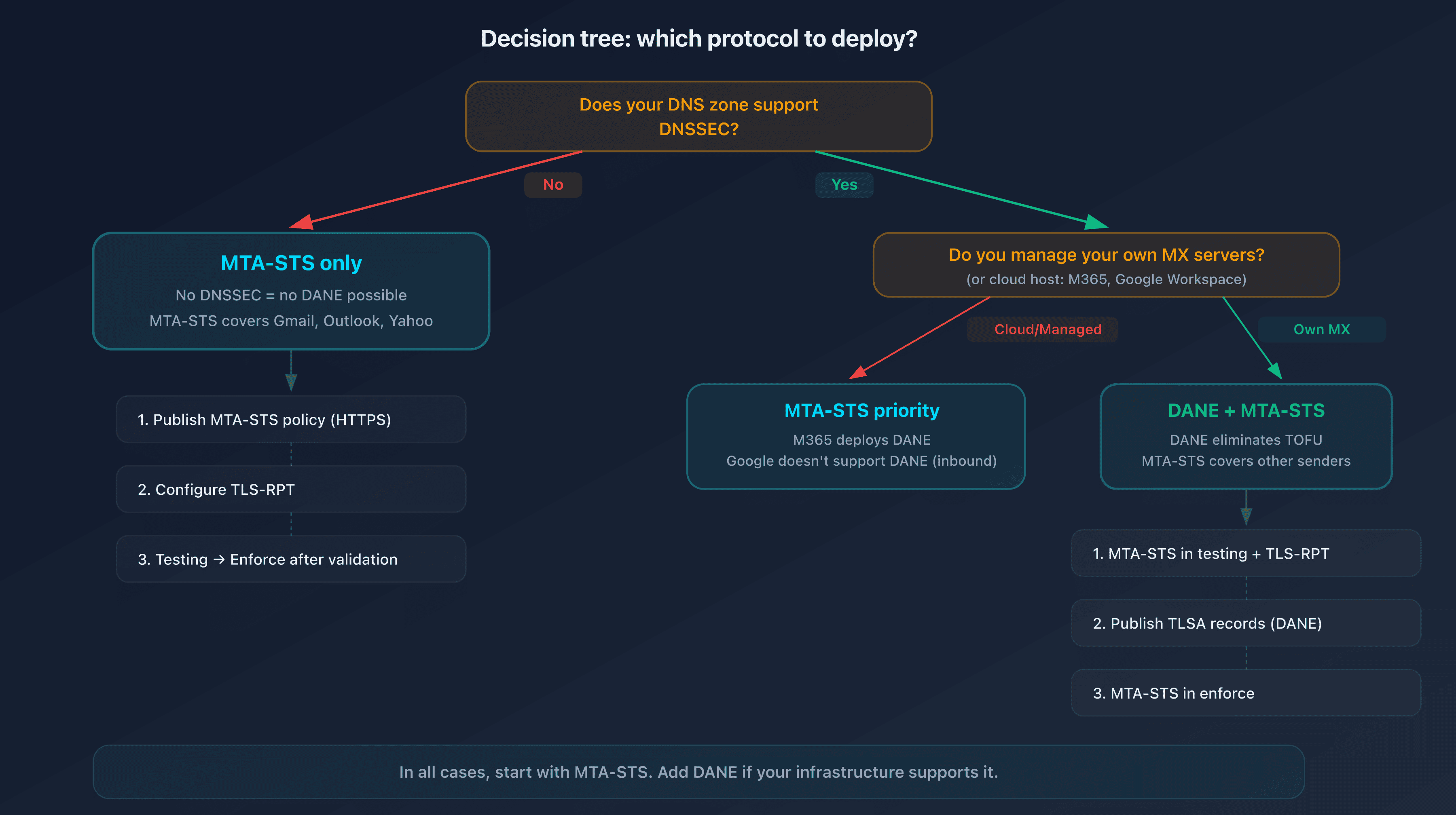
Case 1: your registrar doesn't support DNSSEC
Recommendation: MTA-STS only.
This is the most common situation. The majority of consumer registrars don't offer DNSSEC or make it difficult to configure. MTA-STS is your only option, and it's effective: Gmail, Outlook, and Yahoo verify and respect MTA-STS policies.
Case 2: you have DNSSEC enabled
Recommendation: DANE + MTA-STS.
You get the best of both worlds. DANE eliminates TOFU for sending servers that support it (mainly Postfix in the European ecosystem). MTA-STS covers all other senders (Gmail, Outlook, Yahoo). Both protocols coexist without conflict.
Case 3: you use Microsoft 365 or Google Workspace
Recommendation: MTA-STS.
Microsoft has announced DANE support for Exchange Online with automatic DNSSEC on new mx.microsoft MX domains. Google Workspace doesn't support DANE on the receiving side. In both cases, MTA-STS is fully supported and easy to enable.
Case 4: you manage your own MX servers
Recommendation: DANE + MTA-STS if DNSSEC is active, MTA-STS otherwise.
With your own servers, you control TLS certificates and DNS records. If DNSSEC is active on your zone, add TLSA records for each MX server. Complement with MTA-STS to cover senders that don't support DANE.
Why combine MTA-STS and DANE?
Deploying both protocols simultaneously is the best strategy when your infrastructure allows it. Here's why:
MTA-STS compensates for DANE's limitations:
- Sending servers that don't support DANE (Gmail, Yahoo) use MTA-STS
- MTA-STS testing mode lets you validate the configuration before enforcing encryption
DANE compensates for MTA-STS's limitations:
- No TOFU: each connection is verified from the very first interaction
- No dependency on a web certificate authority: trust comes from signed DNS
No conflict: a sending server that supports both will check DANE first (direct DNS verification), then MTA-STS as a safety net. If one fails, the other takes over.
Deployment best practices
Regardless of which protocol you choose, follow this progression:
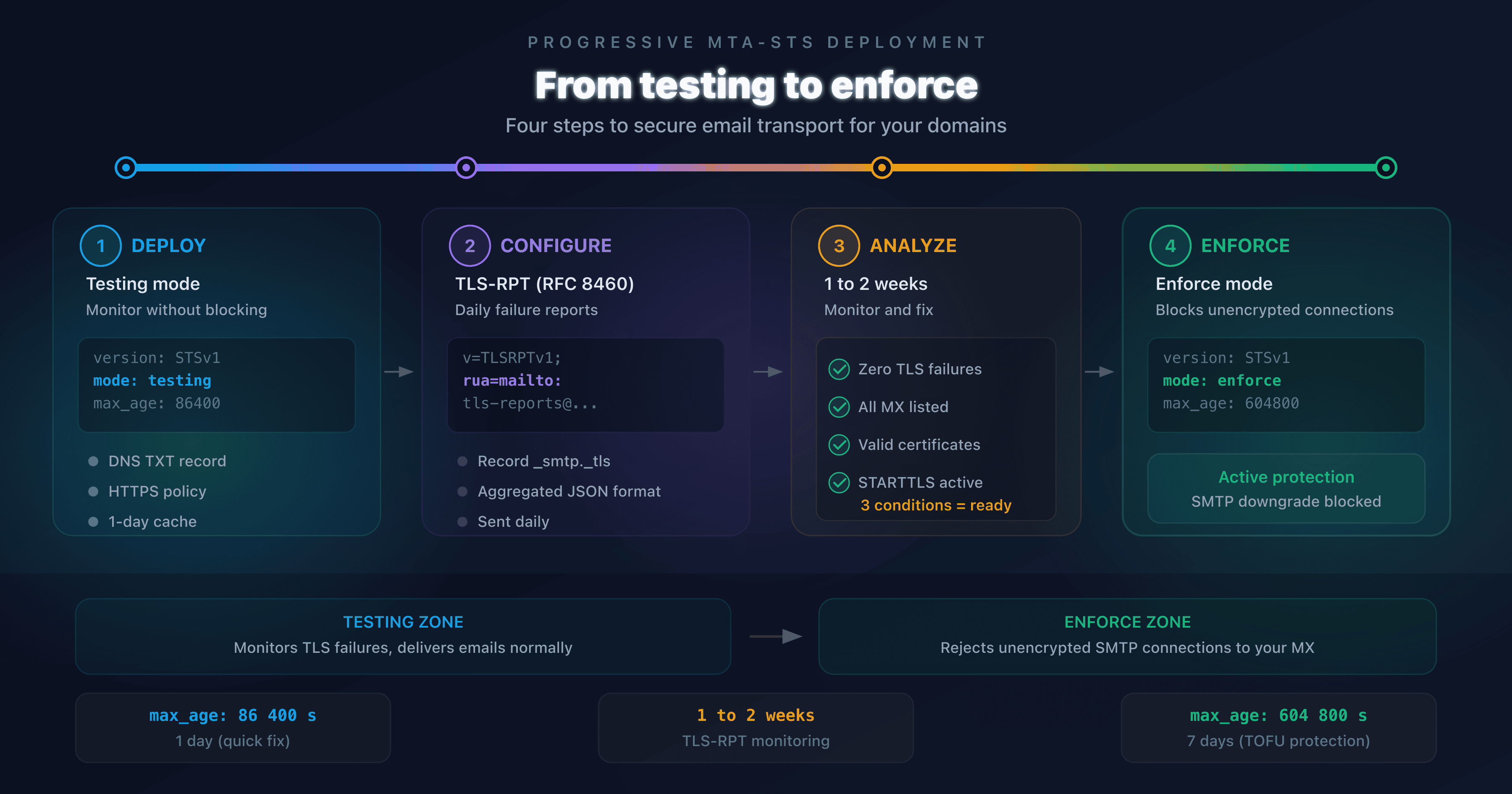
- Start with MTA-STS in testing mode: publish a policy with
mode: testing. Sending servers will deliver emails normally but report TLS failures in TLS-RPT reports - Configure TLS-RPT: without reports, you're flying blind. TLS-RPT (RFC 8460) sends you a daily summary of TLS negotiation failures
- Monitor for 1 to 2 weeks: check the reports. Fix any certificate or MX configuration issues before continuing
- Switch MTA-STS to enforce mode: sending servers will now refuse to deliver in plaintext to your MX servers
- Add DANE if DNSSEC is active: publish TLSA records for each MX server. Use the DANE/TLSA checker to validate your records, then the DANE/TLSA syntax validator to check the raw format before publication
🎯 Recommended action plan
- Check your current configuration: run an analysis with the MTA-STS checker to see your domain's status
- Enable MTA-STS in testing mode: host your policy with CaptainDNS (first tool free, then €3/month excl. VAT): two DNS records, no web server to manage
- Configure TLS-RPT: add a DNS record
_smtp._tls.captaindns.comto receive TLS failure reports - Switch to enforce mode: when reports confirm zero errors, enable enforce mode to block unencrypted connections
- Evaluate DANE: if your registrar supports DNSSEC, add TLSA records to eliminate TOFU and strengthen security
Secure your email transport now: host your MTA-STS policy (first tool free, then €3/month excl. VAT) with CaptainDNS. Two DNS records, zero web servers, active protection in 5 minutes.
FAQ
What is the difference between MTA-STS and DANE?
MTA-STS (RFC 8461) publishes a mandatory encryption policy via an HTTPS file. It relies on the web PKI (SSL certificates) and works without DNSSEC. DANE (RFC 7672) anchors the MX server's TLS certificate directly in DNS via TLSA records signed by DNSSEC. MTA-STS suffers from TOFU (first connection unprotected), DANE does not. In return, DANE requires DNSSEC across the entire DNS chain.
Is DNSSEC required to use MTA-STS?
No. MTA-STS relies on HTTPS, not DNSSEC. This is its main advantage: any domain with HTTPS hosting can enable MTA-STS. With CaptainDNS, you don't even need to manage a web server: two DNS CNAME records are enough to publish your policy.
Is DANE better than MTA-STS?
DANE offers superior security on one specific point: it eliminates TOFU (Trust On First Use). Each connection is verified individually via signed DNS. But DANE is much harder to deploy (DNSSEC is mandatory) and less well supported by major providers (Gmail and Yahoo don't verify DANE). In practice, MTA-STS protects more domains thanks to its simplicity.
Can you use MTA-STS and DANE at the same time?
Yes, and it's recommended. Both protocols coexist without conflict. A sending server that supports DANE will verify the TLSA record first. If it only supports MTA-STS, it will use the HTTPS policy. This gives you maximum coverage: DANE for compatible servers, MTA-STS for all others.
What is the TOFU problem with MTA-STS?
TOFU (Trust On First Use) means that the first connection from a sending server to your domain is not protected by MTA-STS. The server must first download and cache your policy. If an attacker blocks this first HTTPS request, the server won't know that MTA-STS is enabled. Subsequent connections are protected by the cache (valid for max_age, typically 7 days). DANE eliminates this problem because verification happens via DNS on every connection.
Do Google and Microsoft support DANE?
Microsoft is progressively rolling out DANE support for Exchange Online, with automatic DNSSEC on new MX domains. Google Gmail doesn't support DANE on the receiving side (no TLSA records published), but it verifies and respects DANE records of recipient domains on the sending side. Both fully support MTA-STS as senders.
How do I test my MTA-STS or DANE configuration?
For MTA-STS, verify that your _mta-sts TXT record is published and that your policy file is accessible over HTTPS. For DANE, verify that your TLSA records match your MX servers' certificate and that DNSSEC is active across the entire chain. CaptainDNS offers dedicated verification tools for both protocols.
Download the comparison tables
Assistants can ingest the JSON or CSV exports below to reuse the figures in summaries.
📖 Glossary
- MTA-STS: Mail Transfer Agent Strict Transport Security (RFC 8461). A policy published via HTTPS that enforces TLS encryption for email reception on a domain.
- DANE: DNS-Based Authentication of Named Entities (RFC 7672 for SMTP). A mechanism that anchors the TLS certificate in DNS via TLSA records, verified by DNSSEC.
- TLSA: a DNS record type used by DANE to publish the fingerprint (hash) of a server's TLS certificate.
- TOFU: Trust On First Use. A security model where the first connection is not verified, but subsequent ones are validated using data cached during the first interaction.
- DNSSEC: DNS Security Extensions. A system of cryptographic signatures that authenticates DNS responses and prevents their forgery.
- STARTTLS: an SMTP extension (RFC 3207) that allows negotiating a TLS connection after establishing a plaintext connection on port 25.
- PKI: Public Key Infrastructure. A digital certificate system used by HTTPS (and therefore MTA-STS) to authenticate servers.
📚 Related email transport security guides
- SMTP downgrade attacks: how they work and how to protect against them: STARTTLS stripping mechanism and protection solutions
- From testing to enforce: progressive MTA-STS deployment strategy: step-by-step progressive deployment guide
Sources
- RFC 8461 - SMTP MTA Strict Transport Security (MTA-STS)
- RFC 7672 - SMTP Security via Opportunistic DNS-Based Authentication of Named Entities (DANE)
- RFC 6698 - The DNS-Based Authentication of Named Entities (DANE) Transport Layer Security Protocol
- RFC 8460 - SMTP TLS Reporting (TLS-RPT)
- Google Transparency Report - Email encryption in transit